

On 30 July, the European Union launched the much-awaited call for tenders for the construction of its first artificial intelligence gigafactories. Candidates can now submit their projects to build and operate these infrastructures. This article places the announcement in its context, details the funding mechanism structured in two lots and two phases, explains what lies behind the figure of “over €30 billion” and clarifies the status of each commitment. It builds on our analysis of the InvestAI initiative and AI gigafactories and our article on European sovereignty in AI.
Contents:
- Why AI gigafactories in Europe?
- From the InvestAI plan to the call for tenders: continuity and shifts
- What the Commission announced on 30 July 2026
- Two lots, two phases: the funding mechanism in detail
- A target of over €30 billion
- Member States mobilise, with European dependency in the background
- How european economics supports its clients
Why AI gigafactories in Europe?
An AI gigafactory is not a factory in the traditional sense. It is a giant computing centre, equipped with over 100,000 specialised processors, designed to train the most advanced artificial intelligence models. These models, such as large language models (LLMs), require considerable computing power that Europe currently lacks, unlike the United States and China, where massive data centre projects are already under way (AP News, 2025; Newsweek, 2026).
The European Union already has nineteen AI Factories, smaller computing centres (around 25,000 processors) spread across the continent. AI gigafactories represent the change of scale: giving European start-ups, businesses, researchers and public authorities access to world-class computing power, covering the training, inference and fine-tuning of advanced models, on European soil and under European law (EuroHPC JU, 2026). It is a matter of technological sovereignty as much as competitiveness.
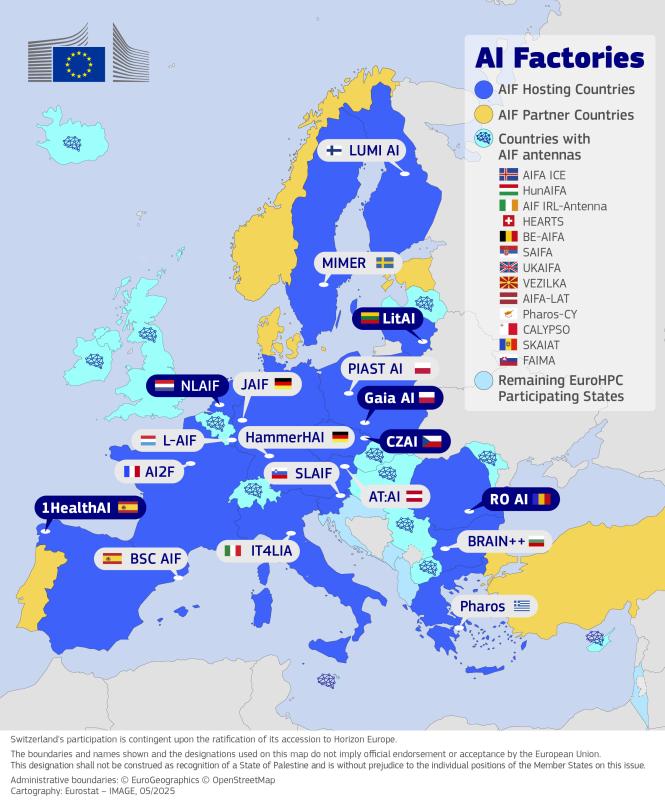
Network of AI Factories and AI Factory Antennas in Europe (European Commission (DG CONNECT), AI Factories, 2025).
From the InvestAI plan to the call for tenders: continuity and shifts
The 30 July announcement is part of a sequence that began a year and a half ago:
- 11 February 2025: at the AI Action Summit in Paris, Commission President Ursula von der Leyen presented the InvestAI plan, which aims to mobilise €200 billion of AI investment in Europe, including €20 billion dedicated to AI gigafactories (European Commission, IP/25/467, 2025).
- Spring 2025: a first call for expressions of interest tested the market: 76 responses from 16 Member States confirmed strong private-sector appetite (EuroHPC JU).
- 16 January 2026: the Council adopted Regulation (EU) 2026/150, which formally entrusts the deployment of the gigafactories to the EuroHPC Joint Undertaking, the body that already manages Europe’s supercomputers. This regulation is an adopted text, now in force.
- 30 July 2026: launch of the call for tenders. The InvestAI plan referred to four to five AI gigafactories; the call now provides for up to seven, the Commission having noted strong interest from Member States and the market (Silicon, 2026).
With this call, the Union is therefore moving from announcements to implementation: candidates can now formally submit their projects.
What the Commission announced on 30 July 2026
The European Commission and the EuroHPC JU have opened a call for tenders to select up to seven AI gigafactories in the Union (European Commission, IP/26/1708, 2026).
The timetable is as follows:
- Submission of applications: until 12 November 2026,
- Award decisions: expected in early 2027,
- Signature of the legal framework and contracts: construction to begin in 2027,
- Entry into service: within a maximum of 18 months of contract signature, meaning the first facilities are expected to become operational around mid-2028 (Euronews, 2026).
Applications are open to consortia and ad hoc entities bringing together businesses, investors and public bodies. Projects may be located on a single site, spread across several sites within one Member State, or take the form of cross-border projects involving several Member States through distributed infrastructure (European Commission, 2026).
Two arrangements complete the framework:
- A joint procurement agreement: eighteen Member States, including France, Germany, Italy and Spain, have signed it with the EuroHPC Joint Undertaking in order to jointly purchase computing time from the future AI gigafactories.
- Letters of intent with the American manufacturers AMD, NVIDIA and Qualcomm: signed by the Commission in the wake of the framework trade agreement concluded between the EU and the United States in the summer of 2025, to secure consortia’s access to hardware. The Commission describes these documents as letters of intent, instruments that are preparatory by nature and distinct from firm supply contracts. Consortia will remain free to source hardware from any supplier established in Europe or in a like-minded country, and part of this procurement may be reserved for European start-ups and scale-ups (Agence Europe, 2026).
Two lots, two phases: the funding mechanism in detail
The call is structured in two lots and two successive development phases, with host Member States providing funding equivalent to that of the European Union (European Commission, 2026).
Lot 1: up to four projects
- Union funding of up to €100 million in the first phase
- Up to a further €400 million in the second phase
- In return: deploying at least as many advanced AI processors as Europe’s most powerful current AI Factory, then tripling that capacity in the second phase
Lot 2: up to three larger projects
- Union funding of up to €200 million in the first phase
- Up to a further €800 million in the second phase
- Capacity requirement raised to at least four times that of Europe’s most powerful AI Factory by the end of the second phase
For reference, Regulation (EU) 2026/150 caps the European Union’s financial contribution at 17% of the capital expenditure (CAPEX) relating to each gigafactory’s overall computing infrastructure. Project selection will also pay particular attention to supplier diversification and data security (EuroHPC, 2026).
A target of over €30 billion
The headline figure deserves to be broken down, as it does not represent €30 billion of public funds already committed. The target combines:
- Up to €10 billion in public funding, provided in equal parts by the Union and the participating Member States
- At least €20 billion in private investment that this public foundation is intended to attract
The logic is that of a catalyst: by guaranteeing funding and public orders for computing time, the Union reduces the risk for private investors and encourages them to commit (European Commission, 2026).
A note of caution is nonetheless warranted. On the European public share, only around €1 billion is available in the Union’s current budget. The remainder depends on the next Multiannual Financial Framework 2028-2035, still under negotiation between Member States. The Commission itself has indicated that the amount announced for the second phase was its best estimate, without being able to prejudge the outcome of the budget negotiations (Euronews, 2026). The €30 billion figure should therefore be read as a target, not as a secured budget.
Member States mobilise, with European dependency in the background
Member State mobilisation is taking place at two levels:
- Ten countries have expressed interest in hosting a gigafactory: Germany, Italy, France, Poland, Czechia, Denmark, Finland, Greece, Portugal and Spain (Euronews, 2026).
- Eighteen Member States have committed, through the joint procurement agreement mentioned above, to purchasing computing time from the future facilities (Euronews, 2026).
Some are going further: France, the first to declare its position, has committed to ordering €100 million of computing capacity from the project selected on its territory (French government, 2026). This is a capacity purchase, not a subsidy, a mechanism that secures the consortia’s future revenues without increasing the public share of the funding.
This mobilisation responds to a well-documented dependency, with cutting-edge computing capacity remaining concentrated in the United States and China. The short-term paradox is acknowledged: to build sovereign infrastructure, the European Union is initially relying on letters of intent with American processor manufacturers.
Two safeguards are provided for, whose reach will depend on the consortia’s choices:
- the procurement clause open to suppliers established in Europe or in like-minded countries, with part of the procurement potentially reserved for European start-ups
- the strategy put in place to limit dependency on any single supplier is among the elements taken into account in the assessment of supply chain security (EuroHPC JU, Tender Specifications, p. 44).
Added to this is the budgetary fragility already mentioned, which conditions the second phase of the programme.
How does european economics support its clients in the AI gigafactories call and related initiatives?
Since 2009, european economics has been supporting businesses in securing national and European public funding and in State aid notifications. Our teams work alongside consortia on project engineering, the preparation of applications and the monitoring of procedures, whether for calls managed by the EuroHPC JU, such as the AI gigafactories call, or for schemes run by the Member States, such as the national calls linked to the IPCEI on the Compute Infrastructure Continuum.
Contact us to structure your consortium and prepare your application for the AI gigafactories call.