IPCEI Conference 2026: preparing for the second wave of European industrial projects
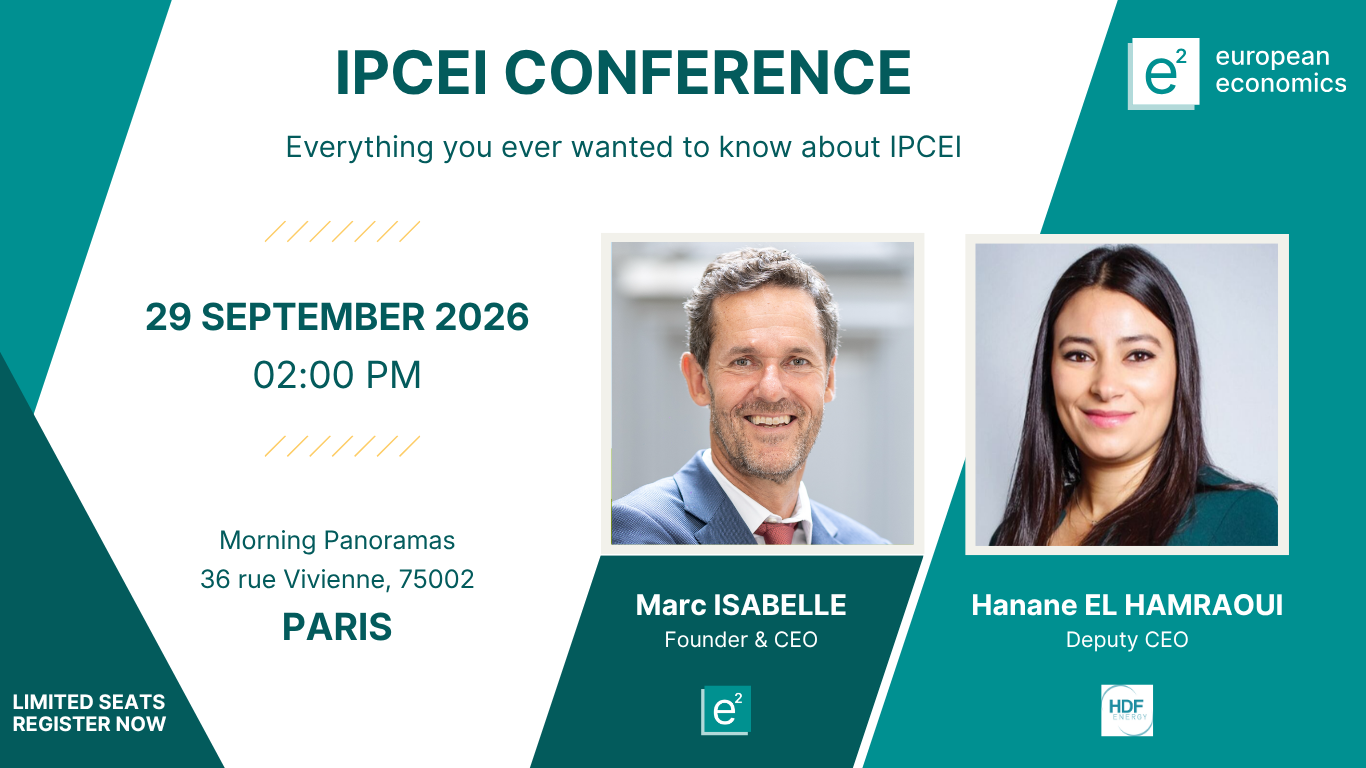
On 29 September 2026, european economics brought together some fifty industrial, financial and institutional stakeholders from across Europe in Paris for the third and final edition of the year of its conference dedicated to Important Projects of Common European Interest (IPCEI).
As a new wave of IPCEI programmes takes shape across Europe, this edition placed the instrument within the broader landscape of public funding, before detailing its rules and illustrating how it works in practice through the journey of a SME.
State aid in the new geo-economic context: the “three clocks”
Opening the session, Iryna SABAT, PhD, Project Director at european economics, offered a reading of State aid through three clocks, around a simple message: public funding has moved from the back office to the boardroom.
- The Washington clock: US incentives and tariffs change the investment equation for the same technology.
- The Beijing clock: a supply chain can run on someone else’s clock, as the April 2025 export controls on rare earth magnets showed, with China accounting for around 91% of global separation and refining in 2024.
- The Europe clock: a strategic project is not always an investable business case, and necessary, proportionate State aid can close the gap, as illustrated by the Infineon Dresden decision (€920 million of German aid approved on 20 February 2025 for a €3.5 billion investment).
The fourth clock belongs to companies themselves: the timing of their preparation, with a defined project, a realistic alternative, a narrative on its dividends for the EU and a financial model ready when the opportunity opens.
Navigating the IPCEI jungle: from the regulatory framework to notification
Marc ISABELLE, Founder and CEO of european economics, then took the audience through the first wave of 11 IPCEIs launched between 2018 and 2025, covering 296 beneficiaries and €37.6 billion of State aid.
He presented the second wave of IPCEIs, now being initiated by the Joint European Forum: from the programmes already launched (advanced semiconductor technologies, artificial intelligence, compute infrastructure continuum, innovative nuclear technologies, circular advanced materials) to those endorsed or still under discussion.
He detailed the regulatory requirements, the stage-gate process from national calls to the notification to the European Commission, and the three components of the notification file, drawing on the lessons learned from the 152 IPCEI projects supported by european economics since 2018. His conclusion: anticipate, coordinate, and push the regulation to its limits.
Case study: HDF Energy’s journey within the IPCEI Hy2Move
Hanane EL HAMRAOUI, Deputy CEO of HDF Energy, shared the experience of this SME within the IPCEI Hy2Move, from the first steps in 2020 to the signature of the funding agreement in December 2025.
She emphasised the key success factors behind this outcome:
- securing national support early and maintaining it through changing political circumstances,
- building a business plan with commercial as well as technical KPIs,
- managing spillovers in a way that protects intellectual property while complying with EU rules,
- developing genuine cross-border collaborations,
- carefully organising pre-financing until public funds are disbursed.
Rich discussions with participants
The Q&A session explored several topics of particular interest to project promoters:
- Spillovers: public funding must benefit the wider European ecosystem; the discussion focused on commitments that contribute to dissemination, in particular towards SMEs and research organisations, while protecting the company’s results against competitors, built progressively over the rounds of questions with the Commission.
- State of the art: demonstrate it with public benchmarks, identify the technical locks, and set KPIs your project will beat; innovation can lie in a new application or scale, not only in the core technology building block.
- Grant request: substantiate it with a funding gap questionnaire from the national application onwards, even where it is not required, as the German IPCEI AST showed when aid intensities were revised downwards after national selection.
- National alignment: State aid is national money; map the ministries involved, secure political support early, and remember that the Member State is your ally until approval and your counterpart in the negotiation afterwards.
- Cash flow: eligible costs can start before the funding agreement is signed, but pre-financing through equity and bank loans must be organised, since the first grant instalment comes late in the process.
- SMEs and start-ups: the associated partner status and simplified rules are designed to widen their access to the next IPCEIs.
- Alternatives: when timing or maturity do not fit the IPCEI, the Innovation Fund or State aid secured under the broad Article 107(3)(c) TFEU offer other routes; sectoral regulations such as the Chips Act or the Critical Medicines Act allow Member States to support manufacturing capacity directly.
A community engaged with European industrial challenges
This third edition brought together large groups, innovative SMEs and institutional stakeholders around a shared observation: State aid has become a lever in investment decisions in Europe, provided its rules are mastered and implementation constraints anticipated. A next edition is planned in Paris in early 2027.
Are you preparing an IPCEI project or assessing your public funding options in Europe? Contact us.


Discover other articles