
IPCEI Advanced Semiconductor Technologies (IPCEI AST)
IPCEI on Advanced Semiconductor Technologies: launch of new calls for expressions of interest in Europe
A strategic opportunity for European semiconductor players
The European Commission and several Member States have initiated the structuring of a new Important Project of Common European Interest (IPCEI) dedicated to advanced semiconductor technologies: the IPCEI Advanced Semiconductor Technologies (IPCEI AST). This project is listed in the European Commission’s Design Support Hub, a mechanism dedicated to supporting Member States in the structuring and implementation of IPCEIs.
IPCEI AST aims to support large-scale industrial and technological projects of European relevance, characterized by a level of risk, complexity, or strategic importance such that they cannot be financed by the market alone.
This initiative is aligned with the European Union’s objectives in terms of industrial competitiveness, value chain resilience, and technological sovereignty in a sector that has become central to the economy, the digital transition, and security.
In this context, several Member States have launched or are preparing to launch national calls for expressions of interest, which constitute a mandatory first step for companies seeking to position themselves within the IPCEI AST framework.
Contents:
- What is IPCEI Advanced Semiconductor Technologies (AST)?
- Why a European IPCEI dedicated to Advanced Semiconductor Technologies?
- Technological domains covered by IPCEI Advanced Semiconductor Technologies
- What is the application process under IPCEI Advanced Semiconductor Technologies?
- What are the eligibility criteria for IPCEI AST projects?
- How european economics supports IPCEI semiconductor projects?
- Summary
What is IPCEI Advanced Semiconductor Technologies (AST)?
IPCEI AST is a project currently under structuring, dedicated to the development of advanced and disruptive semiconductor technologies.
It falls within the IPCEI legal framework under Article 107(3)(b) of the Treaty on the Functioning of the European Union (TFEU), which allows, under strict conditions, coordinated State aid between Member States. The objective is to sustainably strengthen the European Union’s competitiveness, value chain resilience, and technological sovereignty in the strategic semiconductor sector.
Under the IPCEI framework, aid may cover Research, Development and Innovation (R&D&I) activities as well as the First Industrial Deployment (FID) phase, provided that a market failure and an incentive effect are demonstrated.
Eligible costs may include:
- operating expenditure for R&D and first industrial deployment (FID), up to TRL 8,
- depreciation of dedicated assets during the project phase (R&D + FID).
Mass production activities and purely commercial operations are explicitly excluded from eligibility, in accordance with the framework defined by the European Commission.
To understand IPCEI principles and milestones, including IPCEI AST, companies may refer to the Joint European Forum for IPCEI (JEF-IPCEI), which supports the definition, design and assessment of future IPCEIs at European level.

IPCEI AST – Illustration of a connected Europe structured around semiconductors and advanced digital technologies.
Why a European IPCEI dedicated to Advanced Semiconductor Technologies?
Industrial and technological challenges identified at European level
The launch of the IPCEI AST responds to several structural challenges identified at European level:
- a persistent dependency on third countries for certain critical semiconductor technologies (Council of the European Union, 2025),
- fragmentation of research, innovation and first industrialisation efforts across Member States (European Commission, IPCEI framework),
- difficulties in financing highly capital-intensive projects involving significant technological risk (EUmonitor, 2023).
Continuity with previous IPCEIs in microelectronics
The IPCEI AST builds on two earlier Important Projects of Common European Interest in the field of microelectronics:
- IPCEI Microelectronics, approved by the European Commission in 2018, covering in particular sensors, power electronics, materials and advanced integrated circuits,
- IPCEI Microelectronics and Communication Technologies (ME/CT), approved in 2023, covering advanced microelectronics and communication technologies, including R&D, innovation and First Industrial Deployment (TRL 8).
These initiatives have contributed to structuring segments of the European value chain and strengthening cross-border cooperation between industrial players and research centres.
The Specific Role of IPCEI AST in the Innovation Cycle
IPCEI AST primarily targets innovative technologies that have moved beyond the purely exploratory stage, generally from intermediate Technology Readiness Levels (TRL 4-5), and covers phases between R&D and first industrial deployment. These are projects with sufficient maturity to enable industrial scale-up, within the scope defined by the European Commission for IPCEIs.
These stages remain insufficiently covered by traditional instruments. European research programmes such as Horizon Europe mainly target upstream R&D, while national schemes are generally designed for mature and lower-risk industrial investments.
For innovative projects at the pre-industrial stage, characterised by high technological risk and significant capital requirements, traditional instruments may reach their limits. In complementarity with the European Chips Act, IPCEIs provide a dedicated framework to support such initiatives where standard funding mechanisms do not fully cover financing needs.
Complementarity with the European Chips Act
IPCEI AST is coordinated with another national funding framework for the semiconductor sector: the European Chips Act, adopted in 2023.
- IPCEIs primarily finance collaborative projects with a high innovation content, covering R&D and First Industrial Deployment.
- the European Chips Act supports the construction and strengthening of industrial capacities, in particular for first of a kind facilities aimed at the deployment and industrialisation of technologies.
This complementarity seeks to cover the full innovation cycle, from research to industrial deployment, enabling IPCEIs to remain the principal instrument for disruptive innovation, while the Chips Act facilitates its industrial scaling.
Technological domains covered by IPCEI Advanced Semiconductor Technologies
Within IPCEI AST, Member States have agreed on seven major technological domains structuring the scope of eligible projects:
- AI chips and accelerators: specialised computing technologies for artificial intelligence, including ASIC architectures, hardware–software co-design, alternative architectures and integration of open solutions such as RISC-V.
- Chiplets, heterogeneous integration and advanced packaging: modular architectures, heterogeneous integration, interposers, complex system-on-chip solutions, as well as advanced packaging and associated testing technologies.
- Integrated photonic circuits and advanced photonics: integrated photonic circuits, co-packaged photonics, optical interconnects, quantum photonics and next-generation photonic solutions.
- Disruptive sensors for autonomy: advanced sensors for autonomous systems, including image sensors, MEMS, bio, quantum, radar, LiDAR and sensor fusion technologies.
- Power electronics and energy efficiency: GaN, SiC and ultra-wide bandgap technologies, new device architectures and solutions contributing to improved energy efficiency
- Secure communication technologies: hardware technologies for secure communications, including components for next-generation networks, post-quantum cryptography and secure optical communications.
- Enabling technologies across the semiconductor value chain: EDA tools, manufacturing and testing equipment, advanced materials, industrial processes, metrology and critical inputs essential to strengthening European industrial capacity.
What is the application process under IPCEI Advanced Semiconductor Technologies?
The IPCEI AST process is coordinated at European level but implemented in a decentralised manner by each participating Member State. It unfolds through several successive stages.
Calls for expressions of interest and national pre-selection
Each Member State organises national consultations or calls for expressions of interest to identify and pre-select potential projects. Several Member States have already published national calls for expressions of interest in preparation for IPCEI AST.
Indicative timetable of national consultations
Deadlines currently communicated by participating Member States are as follows:
| Country | Closing date |
|---|---|
| Germany | 15 January 2026 |
| Belgium | 30 January 2026 |
| Italy | 30 January 2026 |
| Czech Republic | 31 January 2026 |
| Netherlands | 2 February 2026 |
| Ireland | 4 February 2026 |
| Finland | 11 February 2026 |
| Sweden | 23 February 2026 |
| Poland | 25 March 2026 |
| Romania | 9 April 2026 |
| Portugal | 4 May 2026 |
| Spain | 2 June 2026 |
| France | 1 September 2026 |
| Austria | 7 October 2026 |
During the webinar of 3 July 2025 organised by the Netherlands, Germany and France, the following countries were presented as potential participants: Hungary, Lithuania and Malta.
Download our calendar of upcoming IPCEI deadlines
Project structuring and cross-border matchmaking
IPCEIs require an effective cross-border collaboration in order to demonstrate European added value. Companies must establish a consortium involving at least four Member States.
The matchmaking phase makes it possible to:
- identify complementary partners,
- align technological roadmaps,
- structure integrated value chains at European level.
Pre-notification to the European Commission
The pre-notification phase allows the European Commission to assess in advance the compliance of both the individual project and the integrated IPCEI project with the IPCEI regulatory framework and with State aid rules.
Pre-notification is primarily based on three documents :
- the Project Portfolio, presenting the project, its technological objectives, innovative character and strategic impact,
- the Funding Gap Questionnaire, identifying eligible costs and demonstrating the necessity and proportionality of the requested aid,
- the Prodcom file, used for competitive analysis and assessment of potential impact of the aid on the market.
The quality and consistency of these documents are decisive for continuation of the procedure. Any company selected by its Member State to receive more than EUR 50 million in aid may only be granted the funds following formal approval by the European Commission, after its assessment of the project’s compliance and overall consistency.
Formal notification and State aid assessment
Member States formally notify the envisaged aid measures. Following several rounds of questions and answers with the European Commission, it assesses their compatibility with State aid rules.
Compatibility decision and signature of funding agreement
Following the adoption of a compatibility decision by the European Commission, the funding agreements may be signed and the projects implemented.
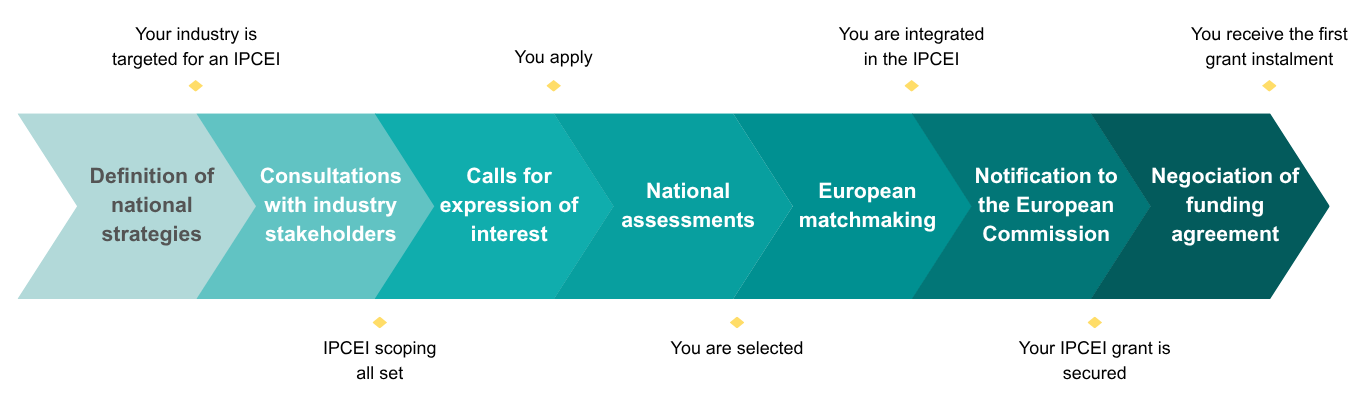
Overview of the IPCEI process: from national strategies to European coordination and pre-notification
What are the eligibility criteria for IPCEI AST projects?
Projects must in particular demonstrate:
- innovation going beyond the global state of the art,
- the existence of market failures preventing implementation without public support,
- effective cross-border cooperation,
- clear commitments regarding knowledge dissemination and European-wide spillover effects.
How european economics supports IPCEI semiconductor projects?
european economics supports IPCEI AST project promoters throughout the project lifecycle, including:
- strategic structuring and positioning of the project,
- eligibility analysis and alignment with IPCEI criteria,
- maximisation of mobilisable funding and securing of the funding gap,
- preparation of national application files and pre-notification submissions to the European Commission
- support through notification and approval by the European Commission.
Since 2018, european economics has supported 151 projects within 14 existing IPCEIs across 13 Member States, contributing to securing €16 billion in State aid approved by the European Commission.
Our support has enabled the maximisation of funding secured, with grants on average twice as high as those obtained by other beneficiaries, while managing all stages leading to approval by the European Commission. To date, european economics has achieved a 100% success rate in procedures conducted before the European Commission.
Summary:
- Instrument: IPCEI Advanced Semiconductor Technologies, currently under structuring
- Legal basis: Article 107(3)(b) TFEU and the IPCEI State aid Communication (2021)
- Objective: to strengthen European competitiveness, resilience and technological sovereignty in semiconductors
- Eligible activities: R&D, innovation, First Industrial Deployment
- Process: national selection, European matchmaking, pre-notification and notification to the Commission
- Key challenge for companies: anticipate national selection phases, engage effectively with the Directorate-General for Competition during Request for nformation and pre-notification stages, and optimise the funding gap through detailed command of the regulatory framework.
Contact us to secure your positioning and maximise your chances of success under IPCEI AST.

