
IPCEI Compute Infrastructure Continuum (IPCEI CIC)
IPCEI on Compute Infrastructure Continuum: calls for expressions of interest and European-level structuring
A strategic opportunity for European stakeholders in cloud, edge, telecommunications and compute infrastructures
The European Commission and several Member States have referenced, within the work of the Joint European Forum for IPCEI (JEF-IPCEI), the structuring of a new Important Project of Common European Interest (IPCEI) dedicated to the Compute Infrastructure Continuum (CIC). This IPCEI focuses on the deployment of a European continuum of digital infrastructures, from cloud to edge. It has been listed in the Design Support Hub of the European Commission since 27 November 2024, confirming its endorsement by Member States.
The IPCEI Compute Infrastructure Continuum aims to support large-scale European infrastructure projects that the market does not finance alone, particularly where they involve a high level of risk, complexity or strategic importance. Within this overall architecture, the IPCEI CIC is presented as the infrastructure pillar of a broader package, complementing the IPCEI AI, focused on R&D and application innovation, and the IPCEI CIS (Cloud Infrastructure and Services) approved by the European Commission at the end of 2023.
In this context, national calls for expressions of interest constitute the operational entry point for companies wishing to position themselves.
Contents:
- What is the IPCEI Compute Infrastructure Continuum (CIC)?
- Why a European IPCEI dedicated to compute infrastructures?
- Which technological domains are covered by the IPCEI CIC?
- What is the application process for IPCEI CIC projects?
- What are the eligibility criteria?
- How does european economics support project promoters?
- Summary
What is the IPCEI Compute Infrastructure Continuum (CIC)?
The IPCEI Compute Infrastructure Continuum falls within the general IPCEI regulatory framework, based on Article 107(3)(b) TFEU and the 2021 IPCEI Communication. This framework allows several Member States, under strict conditions, to coordinate in supporting projects of common European interest through State aid.
The IPCEI CIC focuses on the deployment of a sovereign compute infrastructure in Europe, based on an open, federated, interoperable and multi-provider architecture.
Its ambition is to cover the entire digital value chain, from data centre compute capacities to edge services, including intermediate layers required for orchestration, connectivity and distributed processing.
The objective is to enable European stakeholders to:
- train and run compute-intensive workloads;
- process data as close as possible to its point of production;
- reduce critical technological dependencies;
- benefit from infrastructure aligned with European requirements in terms of security, resilience and governance.
Unlike most of the previous 13 IPCEIs, the IPCEI CIC is not intended to fund R&D and innovation activities. It focuses on the funding and deployment of strategic infrastructures, capable of supporting next-generation digital and industrial uses, particularly in artificial intelligence.
Why a European IPCEI dedicated to compute infrastructures?
The launch of the IPCEI Compute Infrastructure Continuum addresses several structural challenges identified at European level.
Persistent industrial and technological bottlenecks
The consultation phase highlighted several issues:
- insufficient availability of compute capacity adapted to advanced use cases, particularly for AI;
- fragmentation of the European cloud market;
- lack of interoperability between existing infrastructures;
- limited readiness for future needs in distributed computing, latency, cybersecurity and scalability.
In this context, the IPCEI CIC aims to structure a coherent and coordinated European response, based on a federated network approach rather than a juxtaposition of isolated national initiatives.
A digital sovereignty challenge
Beyond technical capabilities, the challenge is also strategic.
The IPCEI CIC aims to build a European ecosystem in which companies can:
- choose their providers without technological lock-in;
- deploy interoperable services;
- process sensitive data within a secure framework;
- rely on infrastructure aligned with European priorities in terms of sovereignty and strategic autonomy.
Continuity with existing European initiatives
The IPCEI CIC builds on the IPCEI CIS (Cloud Infrastructure and Services) approved by the European Commission at the end of 2023.
It extends this logic, with a stronger focus on the deployment of the cloud-edge continuum, interconnection of compute capacities and the development of infrastructures that can operate at scale in the field of artificial intelligence.
It is also articulated with other European initiatives, including:
- the IPCEI Artificial Intelligence (IPCEI AI), focused on R&D;
- AI Factories, currently being deployed under EuroHPC;
- initiatives under discussion relating to very large-scale compute capacities (“AI Gigafactories”);
- the EuroHPC Joint Undertaking;
- the 8ra initiative dedicated to building a resilient digital infrastructure.
The IPCEI CIC therefore represents a cross-cutting infrastructure layer aimed at connecting and orchestrating digital capacities at European scale.
Which technological domains are covered by the IPCEI Compute Infrastructure Continuum?
Several major technological building blocks have been identified in defining the scope of the IPCEI CIC.
Deployment of sovereign cloud-edge infrastructures
The IPCEI CIC covers the deployment of Infrastructure-as-a-Service (IaaS) at European scale.
This includes establishing compute capacities across the European territory, from data centres to regional and local edge nodes.
Federation and interconnection of infrastructures
Another key objective is the creation of an interconnected European network of compute capacities.
Projects included in the IPCEI CIC are expected to contribute to:
- interoperability between infrastructures;
- workload portability;
- seamless data and processing flows;
- orchestration of distributed resources within a common architecture.
Energy efficiency and sustainable computing
The IPCEI CIC also supports the development and deployment of solutions improving the energy efficiency of compute infrastructures.
This dimension is particularly strategic given the rapid growth in demand linked to AI, inference, storage and distributed processing, which may create pressure on European energy markets.
Cloud services and critical AI components
The compute continuum supported under the IPCEI CIC is intended to enable critical AI services, including:
- training;
- inference;
- orchestration;
- distributed computing;
- resource management;
- hosting of specialised models and workloads.
Industrial and critical use cases
Several structuring use cases can be identified, including:
- edge architectures for telecommunications;
- satellite infrastructures supporting AI Factories or AI Gigafactories;
- use cases related to autonomous mobility and ADAS (Advanced Driver Assistance Systems);
- secure computing environments based on zero-trust principles;
- more broadly, critical applications requiring a combination of proximity, resilience and compute capacity.
What is the application process for IPCEI CIC projects?
As with other IPCEIs, the process is coordinated at European level but implemented in a decentralised manner by Member States.
Calls for expressions of interest and national pre-selection
The first step consists of national consultations or calls for expressions of interest (CEIs). Each Member State identifies, at national level, projects capable of contributing to the future integrated European project.
This phase constitutes the formal entry point for companies. Only projects selected at national level can proceed to the next stages.
Indicative timetable of national consultations
| Country | Deadline |
|---|---|
| Slovenia | 16 January 2026 |
| Ireland | 4 February 2026 |
| Poland | 25 March 2026 |
| Italy | 7 May 2026 |
| Germany | 16 October 2026 |
Spain had not yet published its call for expressions of interest as of October 2026.
Download our upcoming IPCEI deadlines calendar
Project structuring and cross-border matchmaking
Once companies have been selected at national level, a phase of European matchmaking is initiated.
This step aims to:
- identify complementarities between participating companies;
- align technological roadmaps;
- structure infrastructure deployment collaborations;
- build an integrated value chain at European level.
The IPCEI logic is not based on a sum of isolated projects, but on a large integrated pan-European project.
Pre-notification to the European Commission (DG Competition)
The pre-notification phase allows the European Commission to assess in advance the compliance of the integrated project, individual projects and the requested aid with the IPCEI framework and State aid rules.
This stage typically relies on several key deliverables:
- a Project Portfolio;
- a Funding Gap analysis;
- a Prodcom market analysis.
All participating Member States submit simultaneously to the European Commission a complete dossier for each company they intend to support. The coordinating Member State also submits the umbrella document describing the IPCEI as a whole.
The European Commission reviews each submitted dossier. Where necessary, it issues Request for Information (RFI) questionnaires to companies requiring additional information in order to take a decision.
For previously approved IPCEIs, companies typically receive between 3 and 5 questionnaires during the pre-notification process.
The European Commission has disqualified a significant number of candidate companies in recent IPCEIs, notably due to difficulties in demonstrating the breakthrough innovation character of their projects.
The European Commission invites Member States to formally notify the aid once it considers that all required information has been provided to support a favourable decision.
Formal notification and State aid assessment
Following the pre-notification phase, which typically lasts several months, Member States formally notify the planned aid to the European Commission, together with the umbrella document.
The European Commission then has two months to take its decision.
Compatibility decision
The Commission adopts a compatibility decision. This decision provides the legal validation of the IPCEI CIC and the aid under Article 107(3)(b) TFEU.
No aid may be granted before its adoption.
The decision is the subject of a European Commission press release on the day it is adopted. However, it is generally published on the Commission’s website only several months later, after confidential information has been redacted in coordination with beneficiary companies and Member States.
Signature of the funding agreement
Following the Commission’s decision, national authorities and beneficiary companies negotiate and sign the funding agreements.
These agreements define the terms for project implementation and aid disbursement.
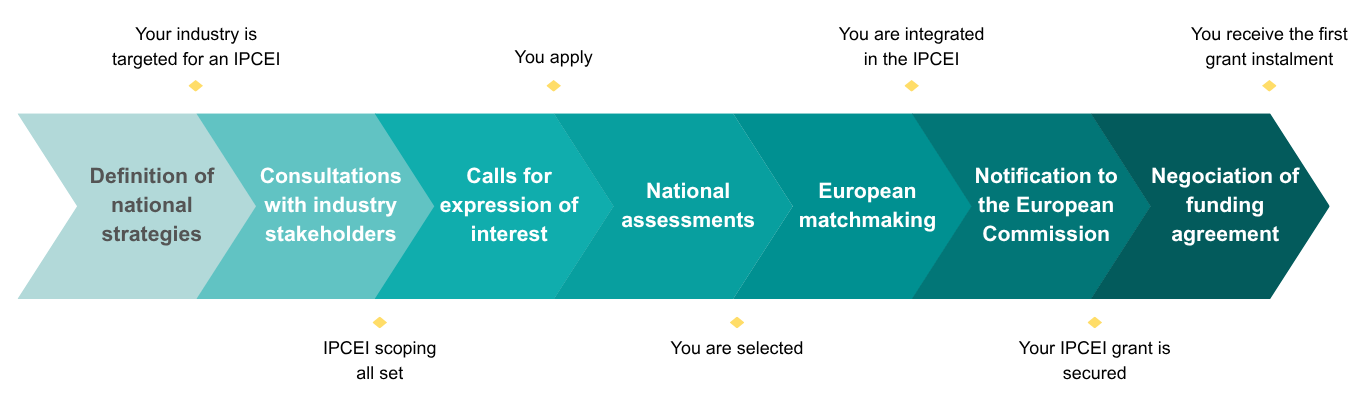
Overview of the IPCEI process: from national strategies to European coordination and pre-notification
What are the eligibility criteria for IPCEI Compute Infrastructure Continuum projects?
Projects must demonstrate compliance with the core IPCEI framework criteria:
- investment in an open and interoperable digital infrastructure;
- the existence of a market failure, justifying the need for public support (funding gap, high uncertainty, capital intensity);
- effective cross-border cooperation within an integrated European project;
- clear commitments to positive spillover effects: network effects, contribution to standardisation, dissemination of knowledge for the benefit of the European ecosystem;
- absence of undue distortions of competition and trade, in terms of market shares or crowding-out of private investment.
In the specific case of the IPCEI CIC, particular attention will be paid to the ability of the integrated project to:
- avoid technological lock-in and the emergence of dominant players;
- strengthen the federation of European capacities;
- provide an open and interoperable infrastructure benefiting a wide range of stakeholders (including SMEs and the public sector);
- demonstrate the necessity of public support in light of investment levels and associated risks.
How does european economics support IPCEI CIC project promoters?
european economics supports IPCEI Compute Infrastructure Continuum project promoters throughout the entire project lifecycle.
This support includes:
- strategic positioning of the project within the European cloud-edge value chain;
- validation of project eligibility under IPCEI regulations;
- structuring of consortia and cross-border partnerships;
- modelling, securing and optimising the funding gap and grant request;
- preparation of national application dossiers;
- preparation of deliverables for pre-notification and notification to the European Commission;
- support through to the Commission’s compatibility decision.
Since 2018, european economics has supported 151 projects across 14 IPCEIs in 13 Member States, contributing to securing €16 billion in State aid approved by the European Commission.
In approved IPCEIs, companies supported by european economics have obtained significantly higher levels of aid than other beneficiaries, with an average of approximately €169 million per project, compared to around €81 million for other participants (i.e. a 2.1x multiplier).
european economics also reports a 90% success rate for national applications in 2026, and 100% since the first IPCEI in 2018 for notification procedures conducted before the European Commission.
In the specific context of the IPCEI CIC, this support aims to secure not only project eligibility but also its positioning within an integrated European infrastructure logic, anticipating the European Commission’s expectations regarding governance, openness, interoperability and financing.
Summary:
- Instrument: IPCEI Compute Infrastructure Continuum (CIC), currently in the phase of national calls for expressions of interest.
- Legal basis: Article 107(3)(b) TFEU, IPCEI Communication (2021)
- Objective: deploy a sovereign, federated, interoperable and multi-provider European compute infrastructure, from cloud to edge.
- Eligible activities: construction of infrastructures up to commissioning.
- Process: national CEIs + pre-selection → European matchmaking → pre-notification → notification → compatibility decision.
- Key challenge for companies: position early, structure a project aligned with IPCEI requirements, demonstrate European added value, secure the funding gap, optimise the aid request and build strong cross-border partnerships.
Contact us to secure your positioning and maximise your chances of success within the IPCEI CIC.

