
IPCEI Innovative Nuclear Technologies (IPCEI Nuclear)
IPCEI on innovative nuclear technologies: national calls and European structuring
A strategic opportunity for innovative nuclear stakeholders
The JEF IPCEI (Joint European Forum for IPCEI) launched in April 2024 a working group on nuclear technologies, which led to the proposal of an IPCEI on Innovative Nuclear Technologies (Innovative Nuclear Technologies). This IPCEI Nuclear was approved by the 13 Member States on 9 April 2025 (Design Support Hub).
At this stage, the process represents, for potential applicants to this IPCEI, an early opportunity for anticipation and strategic preparation.
The key challenge is to prepare to demonstrate the core building blocks of an IPCEI project, in particular its highly innovative nature, the existence of a funding gap (necessity and proportionality of the aid), and commitments ensuring spillover effects for the benefit of the European ecosystem.
Contents:
- What is the IPCEI Innovative Nuclear Technologies?
- Why an IPCEI dedicated to innovative nuclear technologies at European level?
- What technological domains are covered by the IPCEI Innovative Nuclear Technologies?
- What is the application process for projects under the IPCEI Innovative Nuclear Technologies?
- What are the eligibility criteria for IPCEI Nuclear projects?
- How does european economics support project promoters under IPCEI in innovative nuclear?
- Summary
What is the IPCEI Innovative Nuclear Technologies?
IPCEI: a State aid framework for Important Projects of Common European Interest
An IPCEI (Important Project of Common European Interest) is a regulatory framework that enables several Member States to support, through State aid, projects considered important for the European Union in certain industrial value chains regarded as strategic. These projects must make a clear contribution to European objectives and generate spillover benefits beyond the direct beneficiaries. The European Commission assesses these projects under Article 107(3)(b) TFEU and on the basis of the IPCEI Communication (2021).
An IPCEI is not a standalone project. It is an integrated project bringing together several dozen individual projects in at least four Member States, complementary and coherent with one another, structured along a value chain. The integration of individual projects is carried out through structured R&D collaborations under the matchmaking process.
The European Commission (DG COMP) notes that Member States are on the front line: they define the scope, organise national pre-selection and notify the aid. For companies, the operational entry point is therefore the national authority responsible for State aid and IPCEIs.
Eligible activities: R&D&I and First Industrial Deployment (FID)
Within an IPCEI, the following activities may be supported:
- research, development and innovation (R&D&I) activities with a strongly innovative character going beyond the global state of the art;
- as well as a First Industrial Deployment phase (First Industrial Deployment, FID), i.e. reaching TRL 8 (Technology Readiness Level).
The FID is described as the upscaling of pilots, demonstration facilities or “first-of-a-kind” equipment covering post-pilot stages (including testing and ramp-up), excluding mass production and commercial activities (European Commission, 2026).
Why an IPCEI dedicated to innovative nuclear technologies at European level?
The IPCEI Innovative Nuclear Technologies aims to accelerate the development and deployment of innovative nuclear technologies across the European Union.
The objective is twofold:
- to support projects with high technological content and high risk, in order to bridge critical steps between research, demonstration and first industrial deployment;
- to strengthen the integration, resilience and competitiveness of the European nuclear ecosystem, with a value chain and cross-border cooperation approach.
The initiative is associated with several EU strategic priorities:
- contributing to climate neutrality;
- strengthening strategic autonomy and security of supply, in particular in critical energy and industrial sectors;
- potential contributions to health, through certain specific nuclear applications.
These orientations align with the IPCEI logic, which requires a tangible contribution to shared European objectives and major societal challenges (Ministry of Industry and Trade of the Czech Republic, 2025).
A political and investment backdrop
The IPCEI Innovative Nuclear Technologies sits within the strategic framework of the Clean Industrial Deal (European Commission, 2025). This pact sets out industrial and energy orientations at EU level. The first package of operational measures was presented on 2 July 2025. The IPCEI Nuclear therefore aligns with these priorities by contributing to industrial and climate objectives set at European level.
In addition, the adoption of the Nuclear Illustrative Programme (PINC) on 13 June 2025 is an important milestone. The programme indicates an order of magnitude of investment of around €241 billion by 2050 for extending the lifetime of existing reactors and building new large-scale reactors. It also mentions additional needs for Small Modular Reactor/Advanced Modular Reactor (SMR/AMR), microreactors and, in the longer term, fusion (European Commission, 2025).
These elements place IPCEI Nuclear within a broader trajectory of European industrial and energy planning, structured around decarbonisation, competitiveness and security of supply.
Technological domains covered by the IPCEI Innovative Nuclear Technologies
Several technological domains are identified within the IPCEI Innovative Nuclear Technologies. For each, applicants must demonstrate the link between technological challenges, market failures and European objectives (SPF Economie, 2026).
- Innovative nuclear power production (SMR/AMR) and enabling activities
This area covers the production of nuclear-derived energy (electricity and heat) using innovative technologies (SMR/AMR) and associated enabling activities: innovative fuels, uranium processing, waste management, decommissioning and supply chain development.
- Uranium processing and associated fuel services, spent fuel and radioactive waste management and decommissioning: this area covers upstream and downstream parts of the cycle (uranium processing and related services), as well as the management of spent fuel, radioactive waste and decommissioning, for the existing nuclear fleet as well as the fleet under development.
- Supply chain development, transformation and modernisation of industrial sites: this area targets supply chain development and the transformation/modernisation of industrial sites, with a view to strengthening European industrial capabilities.
- Nuclear fusion technologies: the pre-assessment document positions fusion as a technology at an earlier stage, requiring significant investment and progress across several technological building blocks: tritium production, high-temperature superconductivity, magnetic confinement and alternative conceptual approaches, and inertial fusion.
- Production of radioisotopes for medical applications: IPCEI Nuclear also foresees funding R&D work on the production of radioisotopes for medical applications.
What is the process to follow to secure a grant under the IPCEI Innovative Nuclear Technologies?
The IPCEI Nuclear process is coordinated at European level but implemented in a decentralised manner by Member States, under the responsibility of a coordinating Member State. France is coordinator for all R&D and FID activities related to fission; Italy is coordinator for fusion. The process unfolds in several successive steps.
Calls for expressions of interest and national pre-selection
Entry into an IPCEI takes place at national level. Each Member State organises consultations or calls for expressions of interest (CEI) to identify and pre-select projects likely to contribute to the future integrated project. This step is the formal entry point for companies (Design Phase – Step II).
This national application stage is decisive: only pre-selected projects can then take part in European structuring work and the pre-notification phase with the European Commission.
Indicative timetable for national consultations – IPCEI Nuclear
| Member State | Closing date |
|---|---|
| Czechia* | 30 September 2025* |
| Sweden* | 4 December 2025* |
| Belgium | 13 April 2026 |
| Netherlands* | 7 August 2026* |
| Finland | 30 September 2026 |
| Germany | 15 October 2026 |
*This is not a formal call for expressions of interest but an information-gathering exercise conducted by the Member State.
At this stage, among the 13 Member States that approved IPCEI Nuclear, only Belgium and Finland have published a formal call for expressions of interest. The other 11 have not yet launched a formalised national procedure nor communicated a public timetable: Croatia, Spain, France, Hungary, Italy, the Netherlands, Poland, Czechia, Romania, Slovenia and Sweden.
Download our calendar of upcoming IPCEI deadlines
Project structuring and cross-border matchmaking
The matchmaking phase is organised under the aegis of the coordinating Member State. This step aims to connect pre-selected projects, identify complementarities and structure an integrated project based on cross-border R&D collaborations. The cross-border dimension is a core requirement of the IPCEI Communication. Depending on its status, each company selected to participate in the IPCEI must establish collaborations in at least 3 or 4 Member States.
This phase makes it possible, in practical terms, to:
- identify complementary partners along the value chain,
- align technological and industrial roadmaps,
- structure integrated value chains at European level.
The objective is not merely formal cooperation, but the construction of a coherent, integrated pan-European flagship project delivering economic spillovers beyond the direct beneficiaries.
Pre-notification to the European Commission
Pre-notification is a key stage of the IPCEI process. It requires national authorities to submit a structured file to the European Commission in order to anticipate requests for information and secure compliance of the State aid with the IPCEI Communication, under EU State aid rules.
The file is based on three elements:
- Project Portfolio: presentation of the overall project demonstrating that all regulatory criteria of the IPCEI Communication are met.
- Funding Gap: business plan demonstrating the necessity and proportionality of the aid.
- Prodcom market analysis: spreadsheet used to estimate market shares.
The Commission provides official templates on its dedicated IPCEI webpage (European Commission, 2025).
Formal notification and State aid assessment
After the pre-notification phase, Member States formally notify the planned aid to the European Commission. At this stage, it may continue exchanges, request clarifications and finalise its assessment under State aid rules.
The notification procedure is concluded within two months of notification by the adoption of a Commission decision, which examines and validates the compatibility of the aid with the IPCEI framework and Article 107(3)(b) TFEU.
Compatibility decision and signature of the funding agreement
Following the adoption of a compatibility decision, the Commission formally authorises all grants awarded to participating companies under applicable State aid rules. National authorities and beneficiary companies may then sign the funding agreements and begin implementing the projects. The effective disbursement of the aid remains the responsibility of the Member States, in accordance with the terms of the funding agreements.
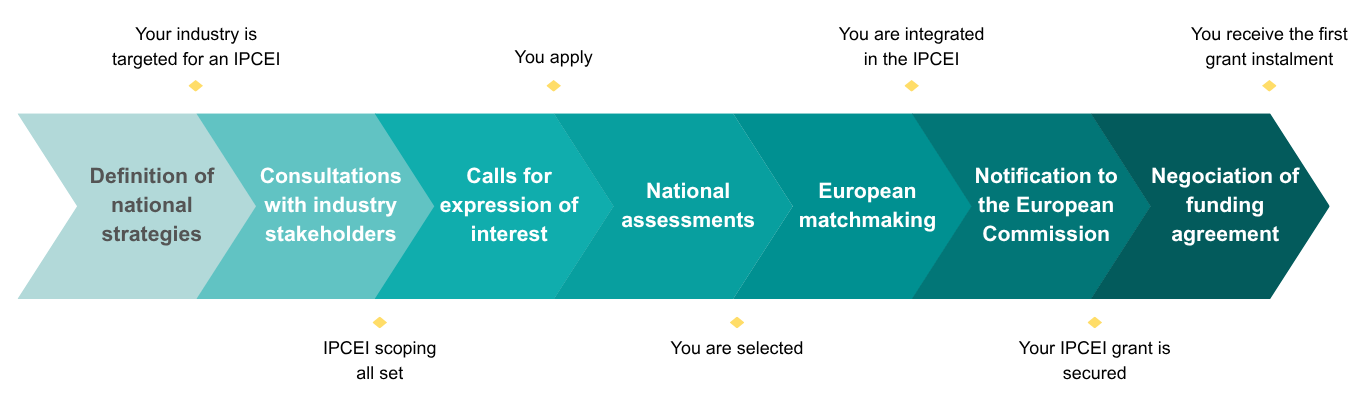
Overview of the IPCEI process: from national strategies to European coordination and pre-notification
What are the eligibility criteria for IPCEI Nuclear projects?
To be selected under IPCEI Nuclear, a project must demonstrate:
- major innovation going beyond the global state of the art;
- the existence of market or systemic failures, justifying the need for public support under the principles of necessity and proportionality;
- effective cross-border collaboration, within an integrated project at European level;
- credible commitments to knowledge dissemination and spillover effects, for the benefit of the European ecosystem beyond the direct beneficiaries;
- the absence of distortions of competition and trade in the EU internal market.
How does european economics support project promoters under IPCEI in innovative nuclear?
european economics supports IPCEI Nuclear project promoters throughout the cycle, from the CEI phase to the Commission decision:
- strategic structuring and positioning of the project within the European value chain;
- eligibility analysis and alignment with IPCEI criteria (no distortion of competition, innovation, funding gap, spillovers, cross-border cooperation);
- optimising the financing available, including modelling and securing the funding gap and the grant application;
- preparing national application files;
- support from pre-notification through to formal notification and approval of the aid by the European Commission.
Since 2018, european economics has supported 151 projects across 14 IPCEIs in 13 Member States, contributing to securing €16 billion in State aid approved by the Commission.
The objective of this support is to maximise the financing available and secure the entire State aid authorisation process up to the compatibility decision, with a 100% success rate in notification procedures conducted before the Commission. Across the 11 IPCEIs already validated by the European Commission, companies supported by european economics secured an average of €169 million in aid per project, while other companies secured €81 million on average (a 2.1x multiple).
Summary:
- Instrument: IPCEI Innovative Nuclear Technologies, currently in the national calls for expressions of interest phase.
- Legal basis: Article 107(3)(b) TFEU, the IPCEI Communication (2021) and DG COMP guidance on conditions/process.
- Objective: Accelerate the development and first industrial deployment of innovative nuclear technologies, strengthen the competitiveness of the European value chain, and contribute to EU strategic priorities (climate neutrality, strategic autonomy, security of supply).
- Eligible activities: R&D&I, First Industrial Deployment (FID), covering activities from TRL 4-5 up to TRL 8.
- Process: national call for expressions of interest, national pre-selection, European cross-border matchmaking, pre-notification and formal notification.
- Key challenge for companies: position early ahead of national calls and structure a project aligned with IPCEI requirements: innovation beyond the state of the art, demonstration of a funding gap, effective cross-border cooperation, spillover commitments, and no distortion of competition and trade, with rigorous preparation of deliverables expected by the European Commission.
Contact us to secure your positioning and maximise your chances of success in IPCEI Nuclear.

