
IPCEI Circular Advanced Materials (IPCEI CAM)
IPCEI on Circular Advanced Materials: national consultations and European structuring
A strategic public funding opportunity for European players in advanced materials, energy, mobility and electronics
The European Commission and numerous Member States have begun structuring a new IPCEI dedicated to Circular Advanced Materials (IPCEI CAM). This strategic value chain was selected for a new IPCEI on 27 November 2024 by 15 Member States and integrated into the Design Support Hub, the European mechanism supporting the design phase of future IPCEIs before their operational launch.
The IPCEI CAM is intended to support innovative industrial projects of European scale focusing on circular advanced materials in service of clean technologies. The objective is to bring forward projects that are too risky, too complex or too ambitious to be financed by the market alone, in order to strengthen the competitiveness, industrial resilience and strategic autonomy of the European Union in three strategic sectors: energy, mobility and electronics.
In this context, national consultations and calls for expressions of interest constitute two operational entry points for companies wishing to position themselves on the IPCEI CAM as early as possible.
Contents:
- What is the IPCEI Circular Advanced Materials?
- Why an IPCEI dedicated to circular advanced materials?
- What are the technological domains covered by the IPCEI CAM?
- What is the project application process for the IPCEI CAM?
- What are the eligibility criteria for IPCEI Circular Advanced Materials projects?
- How does european economics support IPCEI CAM project promoters?
- Summary
What is the IPCEI Circular Advanced Materials?
The IPCEI CAM falls within the regulatory framework of IPCEIs, based on Article 107(3)(b) of the TFEU (Treaty on the Functioning of the European Union) and on the 2021 IPCEI Communication. As with other IPCEIs, it is a mechanism enabling several Member States to coordinate State aid in favour of projects deemed to be of common European interest, subject to compliance with strict criteria relating to innovation, European integration, necessity and proportionality of aid, and absence of major distortions of competition and trade.
The scope of the IPCEI CAM targets the development and scaling up of advanced materials that are more circular, more recyclable and more easily manufacturable, with a logic of integrating circularity across the entire value chain and throughout the innovation cycle. The identified objectives also include reducing European dependencies on extra-European critical raw materials and improving the energy efficiency of the technologies concerned.
In line with the IPCEI logic, the expected projects cover the full spectrum of R&D&I (from TRL4-5 onwards), through to technological maturity and up to first industrial deployment (FID, TRL8), with particular attention paid to the creation of positive spillover effects beyond the sole beneficiaries of State subsidies.
Why an IPCEI dedicated to circular advanced materials?
The launch of the IPCEI CAM responds to several industrial and technological bottlenecks identified at European level: high dependence on critical inputs, elevated R&D and industrialisation costs, lengthy time-to-market, and difficulty in establishing circular business models at industrial scale. In the energy, mobility and electronics sectors, these constraints directly affect technological sovereignty and European competitiveness.
The initiative also forms part of a broader trajectory of European industrial policy on advanced materials. The European Commission has identified them as a priority lever for key sectors such as mobility, electronics, energy and construction, whilst developing complementary instruments such as Materials Commons, the IAM4EU partnership, the EIC 2025 challenge dedicated to accelerating the development and upscaling of advanced materials, as well as an Advanced Materials Academy announced for the first half of 2026.
The IPCEI CAM is thus intended to fill a gap insufficiently covered by conventional instruments: that of projects which no longer fall solely within upstream research, but which still need to overcome critical stages of industrial structuring, validation, scaling up and first market deployment, stages commonly referred to as the valley of death. It constitutes, in this regard, a targeted instrument to support projects with high technological intensity and strong systemic impact on the European economy.
What are the technological domains covered by the IPCEI CAM?
The IPCEI CAM is intended to structure a complete value chain for circular advanced materials. Five major technological domains are covered by this IPCEI:
- Sustainable sourcing and materials processing: this first area covers access to more sustainable inputs, their treatment and preparation, with particular attention paid to reducing strategic dependencies and strengthening the robustness of the value chain.
- Eco-design and materials innovation: projects may focus on new materials, new formulations, new architectures or design approaches integrating circularity, performance and manufacturability requirements from the outset.
- Circular manufacturing processes: the improvement or transformation of industrial processes in order to reduce material intensity, improve energy efficiency, facilitate component reuse and better integrate circularity constraints at production level.
- Recycling, recovery and end-of-life: a significant part of the scope targets technologies enabling material recovery, valorisation of complex streams, end-of-life treatment and reintegration of materials into new industrial loops.
- In-use circularity: the ambition is not limited to manufacturing; it also encompasses the optimisation of durability, repairability, disassembly, reuse and, more broadly, circular performance throughout the lifetime of applications.
Three major application domains are highlighted:
- Energy: advanced materials for renewable or low-carbon energy conversion, storage, transmission and distribution networks, as well as renewable fuels.
- Mobility: solutions related to energy storage and alternative fuels, lightweight and high-performance materials, durability and protection of transport means and infrastructure, as well as improvement of environmental performance.
- Electronics: advanced materials for energy efficiency, system performance, as well as for more sustainable and more circular chip production and advanced packaging.
What is the project application process for the IPCEI CAM?
As with other IPCEIs, the process is coordinated at European level but implemented on a decentralised basis by the Member States.
Member States remain at the forefront in defining their positioning, organising their national consultations, pre-selecting projects and subsequently preparing the State aid notification phase to the European Commission.
Calls for expressions of interest and national pre-selection
Several public consultations or national calls for expressions of interest have been publicly identified for the IPCEI CAM.
These consultations constitute the first formal step for companies. Only projects supported or pre-selected at national level may fully participate in the structuring of the future integrated European project.
Indicative timetable of national consultations for the IPCEI CAM
| Country | Closing date |
|---|---|
| Slovenia | 15 May 2026 |
| Belgium | 15 June 2026 |
| Austria | 13 July 2026 |
| Finland | 16 August 2026 |
| Spain | 18 September 2026 |
| Poland | 30 September 2026 |
| Italy | 21 October 2026 |
Download our timetable of upcoming IPCEI deadlines
Project structuring and European matchmaking
An IPCEI cannot consist of a collection of isolated projects; it must be structured as a large integrated pan-European project.
The matchmaking phase aims to identify complementary projects among those pre-selected at national level, to align technological roadmaps and to organise genuine cross-border cooperation. This phase seeks to build a coherent whole involving companies across Member States, generating synergies throughout the value chain.
Pre-notification to the European Commission (DG Competition)
The pre-notification phase serves to secure the compliance of both the integrated project and individual projects with the IPCEI framework and State aid rules.
It is based on three standardised deliverables:
- Project Portfolio,
- Funding Gap,
- PRODCOM Market Analysis.
On the basis of these documents, the Commission examines the compatibility of the aid with Article 107(3)(b) of the TFEU, the IPCEI Communication (2021) and, more broadly, applicable European State aid rules. This stage involves exchanges with DG Competition, in the form of requests for information and iterations on the completeness, coherence and quality of the elements submitted.
State aid notification is a regulatory obligation incumbent upon Member States under Article 108(3) of the TFEU. However, in order to carry out its compliance verification, the European Commission requires information primarily concerning the beneficiary undertaking, its project and the target market. This is why beneficiary undertakings must prepare their own pre-notification dossier and respond to the European Commission’s questions (over 100 questions per dossier).
Formal notification and State aid assessment
At the conclusion of the pre-notification procedure, at the invitation of the European Commission, the Member States formally notify the aid they intend to grant to the projects selected within the framework of the IPCEI CAM. The European Commission is required to take its compatibility decision within two months of the notification date.
Compatibility decision
At the conclusion of its analysis, the European Commission adopts a compatibility decision.
This decision provides the legal validation of the notified aid in light of the IPCEI framework and authorises its implementation by the participating Member States.
No aid may be disbursed to beneficiary undertakings before the adoption of this decision.
The decision is the subject of a European Commission press release on the day it is taken (see for example press release IP/23/3087 of 8 June 2023 relating to the IPCEI ME/CT).
The decision itself is published by the Commission several months later, following the redaction of all confidential information (see for example decision C(2023) 3817 final of 8 June 2023, published in its non-confidential version in 2024, case SA.101129).
Signing of the funding agreement
Once the compatibility decision has been adopted, the national authorities may negotiate and sign funding agreements with the beneficiary undertakings.
These agreements specify the terms of aid allocation, the commitments of the project promoter, as well as the timetable and conditions for disbursement.
Operational implementation and the effective disbursement of aid are then the responsibility of the Member States and contingent upon the proper execution of the project. For each funded project, annual reporting is submitted to the European Commission to enable it to monitor proper execution.
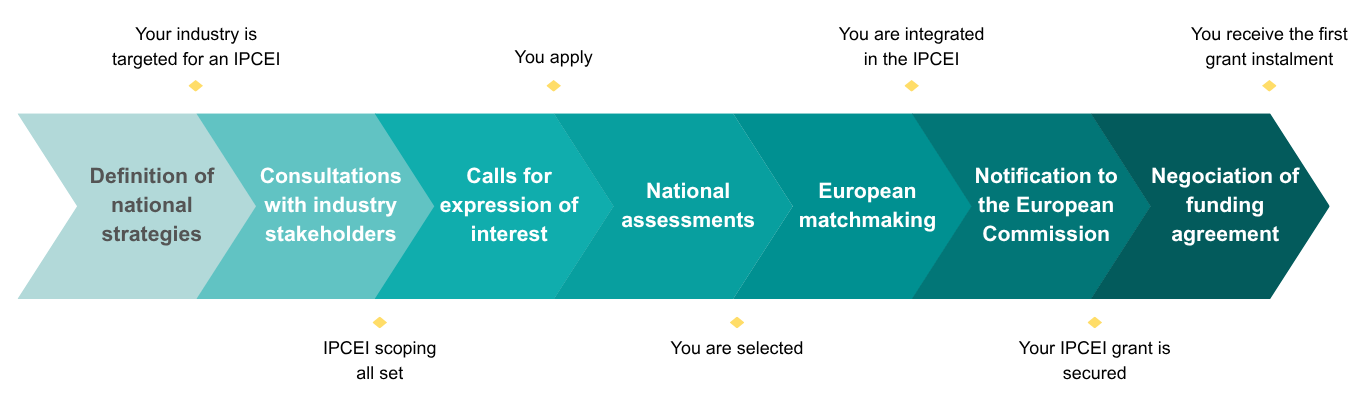
Overview of the IPCEI process: from the definition of national strategies to European collaboration and pre-notification to the Commission
What are the eligibility criteria for IPCEI Circular Advanced Materials projects?
As with any IPCEI, projects must demonstrate their compatibility with European rules on competition and State aid, namely in respect of IPCEIs:
- A major innovation,
- One or more market failure(s) justifying the aid,
- Effective cross-border cooperation,
- Spillovers benefiting the European economy,
- The necessity and proportionality of the aid,
- An absence of major distortion of competition and trade.
In the specific case of the CAM, projects are expected to demonstrate their capacity to integrate circularity credibly across the entire value chain, to improve recyclability, manufacturability and resource efficiency, and to contribute to reducing the strategic dependencies of the European Union.
How does european economics support IPCEI CAM project promoters?
european economics supports CAM project promoters throughout the entire cycle:
- Strategic positioning within the European value chain,
- Eligibility analysis against IPCEI criteria,
- Structuring of the cross-border consortium,
- Modelling, securing and optimising the funding gap,
- Preparation of national applications,
- Preparation of pre-notification and notification deliverables,
- Support through to the European Commission’s compatibility decision.
Since 2018, we have supported 151 projects across 14 IPCEIs in 13 Member States, helping to secure €16 billion in State aid approved by the European Commission.
For new IPCEIs, we have an 85% success rate at the national calls for expressions of interest stage. We also have a 100% success rate in individual notification proceedings before the Commission. The undertakings we have supported obtained an average aid of €169 million per project, compared with €81 million on average for other beneficiaries, representing a multiplier of 2.1.
Summary:
- Instrument: IPCEI Circular Advanced Materials (CAM), currently in the national calls for expressions of interest phase.
- Legal basis: Article 107(3)(b) TFEU, IPCEI Communication (2021)
- Objective: to strengthen circularity, industrial competitiveness, resource efficiency and the strategic autonomy of the European Union in the energy, mobility and electronics value chains.
- Eligible activities: R&D (from TRL4-5 onwards) + First Industrial Deployment (FID, TRL8).
- Process: national calls for expressions of interest + national pre-selection → European matchmaking → pre-notification → formal notification → compatibility decision.
- Key challenge for companies: to position early, structure a genuinely European project, demonstrate innovation, build the funding gap, identify spillovers and the project’s concrete contribution to the circularity of clean technologies.
Contact us to secure your positioning and maximise your chances of success in the IPCEI CAM.

