
IPCEI Biotechnologies (IPCEI Biotech)
IPCEI on industrial biotechnologies: national calls and European structuring
A strategic opportunity for European biotechnology players
The European Commission and several Member States have begun structuring new Important Projects of Common European Interest (IPCEI) dedicated to biotechnologies. On 24 November 2025, the Joint European Forum for IPCEI (JEF‑IPCEI) endorsed the launch of the design phase of three IPCEI candidates in the field of biotechnologies.
These three candidates focus respectively on bio-based chemicals, bio-based materials and bio-based ingredients for food and feed (biotechnologies for food and feed).
These initiatives are intended to support industrial and technological projects of European scale, presenting a level of risk, complexity or strategic importance such that they cannot be financed by the market alone. In this context, future national consultations and calls for expressions of interest will constitute the operational entry point for companies wishing to position themselves.
Contents:
- What is the IPCEI Biotechnologies?
- Why an IPCEI dedicated to biotechnologies at European level?
- What are the technological domains covered by the IPCEI Biotechnologies?
- What is the project application process for the IPCEI Biotech?
- What are the eligibility criteria for IPCEI Biotechnologies projects?
- How does european economics support IPCEI Biotech project promoters?
- Summary
What is the IPCEI Biotechnologies?
IPCEI: a State aid framework for important projects of common European interest
An IPCEI (Important Project of Common European Interest) is a regulatory framework that enables several Member States to support, by means of coordinated State aid, projects deemed important for the European Union in industrial value chains considered strategic. These projects must make a clear contribution to European objectives and generate spillovers beyond the direct beneficiaries alone.
The IPCEI Biotech falls within this general regulatory framework, based on Article 107(3)(b) of the Treaty on the Functioning of the European Union (TFEU) and on the 2021 IPCEI Communication. This framework authorises, under strict conditions, the granting of State aid for important projects of common European interest, subject to compliance with criteria relating to innovation, European integration, necessity and proportionality of aid, and the absence of major distortions of competition and trade.
An IPCEI is not an isolated project. It is a large integrated project bringing together, through collaboration, several individual projects across at least four Member States. These projects must be complementary and coherent with one another, form part of a single technological roadmap, and be structured along a value chain.
Three IPCEI candidates in the field of biotechnology
There will be three distinct Biotech IPCEIs (European Commission, 2025):
- IPCEI on bio-based chemicals,
- IPCEI on bio-based materials,
- IPCEI on biotechnologies for food and feed.
These three projects are being prepared by a Biotechnology‑IPCEI working group bringing together 15 Member States, co‑led by Germany, Finland and Estonia. Finland coordinates the design phase of the IPCEI on bio-based materials (Business Finland, 2026).
Funded activities: R&D&I and First Industrial Deployment (FID)
Within an IPCEI, the activities that may be funded cover:
- research, development and innovation activities (R&D&I, from TRL4-5 onwards) of a highly innovative nature, going beyond the global state of the art;
- First Industrial Deployment (FID, transition from TRL7 to TRL8) phases, corresponding to the scaling up of pilots, demonstration facilities or “first-of-a-kind” equipment, excluding purely commercial activities.
For the biotechnologies candidates, this scope targets in particular the scaling up of bioprocesses and biorefineries whose capital requirements and “valley of death” risks are too high to be borne by the market, whether on the supply side, the demand side or the financing side.
Why an IPCEI dedicated to biotechnologies at European level?
Industrial and technological challenges identified at European level
The launch of the IPCEI Biotech candidates responds to several structural challenges identified at European level:
- a strong dependence of European industry on fossil-based carbon inputs, in the production of chemicals, materials and food components,
- high capital requirements and risks for the transition from research to first industrialisation of bioprocesses,
- growing pressures on land, water and food resources, calling for solutions involving sustainable proteins, functional ingredients and other components for food and feed.
The objectives identified for the IPCEI Biotech include replacing fossil carbon with renewable carbon derived from biomass, recycling and CO₂ capture, as well as harnessing European strengths in the bioeconomy to support the creation of high-value-added industrial activities and jobs in the European Union.
A backdrop of industrial and regulatory policy
The Biotech IPCEIs form part of a broader trajectory of European policy dedicated to the bioeconomy and biotechnologies. Several initiatives frame this movement, with different statuses that should be distinguished:
- the Bioeconomy Strategy, namely the Communication on a strategic framework for a competitive and sustainable bioeconomy, adopted on 27 November 2025. It defines the public policy framework within which the future Biotech Acts fall,
- the Biotech Act I, focused on health, proposed by the European Commission on 16 December 2025. This proposal has entered the legislative negotiation phase between the European Parliament and the Council,
- the Biotech Act II, dedicated to industrial biotechnologies and biomanufacturing, announced in the Commission’s 2026 work programme and expected in the third quarter of 2026. A call for evidence was opened until 10 June 2026.
These elements situate the IPCEI Biotech within a European industrial policy logic structured around decarbonisation, the reduction of dependencies on fossil resources, competitiveness and security of supply.
What are the technological domains covered by the IPCEI Biotechnologies?
The three IPCEI Biotech candidates have been described in three scoping papers prepared by the working group, in consultation with European organisations representing industry and research. Their purpose is to identify, at this early stage, the fields of activity most suited to the IPCEI framework.
Bio-based chemicals
This strand targets the use of renewable carbon to produce base molecules, whether “drop-in” molecules or new platform molecules (for example ethylene or FDCA), feeding several value chains, from polymers to agrochemicals. The objective is to reduce dependence on fossil carbon and CO₂ emissions.
Bio-based materials
This strand focuses on transforming sustainable biomass, waste and biogenic CO₂ into high-value-added materials for applications such as packaging, textiles, construction and automotive. The projects concentrate on the development and first industrial deployment of innovative transformation processes, as well as the use of these bio-based materials across numerous application sectors. The objective is to contribute to greater resource-use efficiency and to the resilience of the European economy through the substitution of imported fossil-based materials.
Bio-based ingredients for food and feed (key components for food and feed)
This strand targets the deployment of advanced fermentation, cellular agriculture and innovative bioprocesses to produce alternative proteins, vitamins, enzymes and functional ingredients intended for food and feed. It addresses challenges relating to climate, food security and health, and presupposes cross-border capabilities for moving from pilot to demonstration, shared datasets for safety testing and demand-aggregation mechanisms.
A logic of complementarity
The three strands are presented as complementary and capable of coexisting within integrated biorefineries, valorising each fraction of the biomass and creating circular, low-carbon inputs for chemicals, materials and food.
What is the project application process for the IPCEI Biotech?
As with other IPCEIs, the process is coordinated at European level but implemented on a decentralised basis by the Member States. It unfolds in several successive stages.
Calls for expressions of interest and national pre-selection
Entry into an IPCEI takes place at national level. Each participating Member State organises its own consultations, calls for expressions of interest or calls for projects in order to identify the companies likely to contribute to the future integrated European project and to determine the subsidies that could be allocated to them.
This stage is decisive: only projects pre-selected at national level may subsequently take part in the European structuring stages (drafting of the chapeau document), in matchmaking and in the preparation of the State aid pre-notification dossiers.
Indicative timetable of national consultations for the IPCEI Biotech
| Country | Closing date |
|---|---|
| Netherlands* | 5 July 2026* |
| Estonia | 31 August 2026 |
| Belgium | 4 September 2026 |
| Finland | 6 September 2026 |
| Slovenia | 15 September 2026 |
| Portugal | 18 September 2026 |
| Italy | 24 September 2026 |
| Poland | 30 September 2026 |
| Hungary | 2 October 2026 |
*This is not a formal call for expressions of interest but an information-gathering exercise conducted by the Member State.
Download our timetable of upcoming IPCEI deadlines
Project structuring and European matchmaking
Once the projects have been pre-selected at national level, a European matchmaking phase is organised.
This phase aims to:
- identify complementary partners across different Member States,
- align technological roadmaps,
- structure integrated European value chains,
- organise R&D and first industrial deployment collaborations,
- strengthen the expected diffusion and spillover effects.
Within the IPCEI Biotech, this stage will be particularly important in demonstrating the integration between projects on bio-based chemicals, bio-based materials and bio-based ingredients for food and feed.
The aim is not to juxtapose national projects, but to build a coherent large pan-European project, based on industrial, technological and geographical complementarities.
Pre-notification to the European Commission (DG Competition)
The pre-notification phase enables the European Commission, and in particular DG Competition, to examine in advance the compatibility of the envisaged aid with European State aid rules.
It is based on three structuring deliverables:
- the Project Portfolio, which sets out the project, its objectives, its innovative nature, its contribution to the IPCEI and its spillover effects,
- the Funding Gap, a Business Plan that identifies the eligible costs and demonstrates the necessity and proportionality of the public aid requested,
- the PRODCOM market analysis, enabling assessment of the market shares of the beneficiary undertakings and their competitors, and of any risks of distortion of competition and trade within the single market.
This stage requires particular attention to the demonstration of innovation, the definition of the relevant market, the justification of the market failure and the distinction between first industrial deployment and mass production.
This phase may give rise to several requests for additional information. Companies must therefore anticipate a high level of requirements, in particular regarding:
- innovation beyond the global state of the art,
- the exact scope of eligible costs,
- the expected level of profitability without aid and with aid,
- the counterfactual scenario,
- spillover commitments,
- the absence of major distortion of competition and trade.
Formal notification and State aid assessment
After the pre-notification phase, once all beneficiary undertakings have answered all of the European Commission’s questions, the Member States formally notify the envisaged aid.
The Commission then assesses the compatibility of the aid with the IPCEI framework, Article 107(3)(b) TFEU and the 2021 IPCEI Communication: to this end, it carries out a balancing of the positive and negative economic effects of the State aid.
Compatibility decision
At the conclusion of the notification phase, the European Commission adopts a compatibility decision.
This decision legally authorises the Member States to grant the public aid to the beneficiary undertakings.
No aid may be disbursed before the adoption of this decision.
Signing of the funding agreement
Following the compatibility decision, the national authorities may negotiate and sign the funding agreements with the beneficiary undertakings. These agreements define the project implementation arrangements, the milestones, the commitments, the disbursement conditions and the reporting obligations.
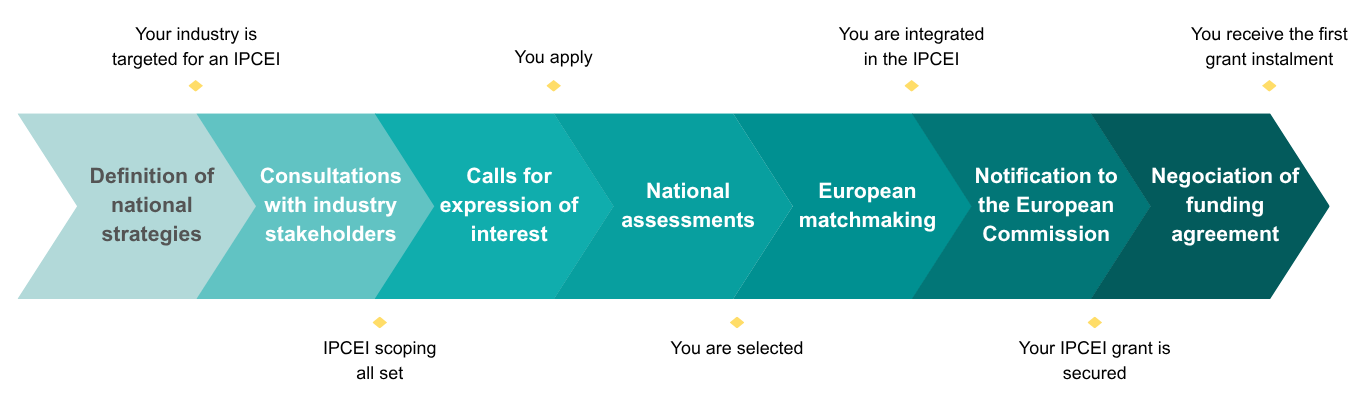
Overview of the IPCEI process: from national strategies to European coordination and pre-notification
What are the eligibility criteria for IPCEI Biotechnologies projects?
As with any IPCEI, projects must in particular demonstrate:
- a major innovation, exceeding the global state of the art,
- the existence of one or more market failures justifying the aid,
- a high level of technological, industrial or financial risk,
- an effective cross-border cooperation,
- a contribution to an integrated project of common European interest,
- significant diffusion effects benefiting the European ecosystem,
- the necessity and proportionality of the aid,
- an absence of major distortion of competition and trade.
In the specific case of biotechnologies, projects are expected to demonstrate their capacity to integrate credibly the replacement of fossil carbon with renewable carbon, to improve resource efficiency and circularity, and to contribute to reducing the strategic dependencies of the European Union.
How does european economics support IPCEI Biotech project promoters?
european economics supports IPCEI project promoters throughout the project life cycle, from the national consultation phase through to the European Commission’s decision:
- the strategic positioning of the project within the European biotechnologies value chain,
- eligibility analysis against the IPCEI criteria (innovation beyond the state of the art, funding gap, cross-border cooperation, spillovers, absence of distortion of competition),
- the modelling, securing and optimisation of the funding gap and the subsidy request,
- the preparation of national application dossiers,
- the preparation of pre-notification and notification deliverables,
- support through to the European Commission’s compatibility decision.
Since 2018, european economics has supported 151 projects across 14 IPCEIs in 13 Member States, helping to secure €16 billion in State aid approved by the European Commission. In the IPCEIs already approved, the undertakings supported by european economics obtained an average aid of €169 million per project, compared with €81 million on average for other beneficiaries, representing a multiplier of 2.1. european economics has a 100% success rate in notification proceedings before the European Commission, and 85% for applications to national calls for projects (2025-2026).
The major added value of european economics’ support is to enable its clients to look ahead across the entire process as quickly as possible by anticipating the expectations of the Member States and the European Commission on matters of innovation, funding gap, spillovers and cross-border cooperation.
Summary:
- Instrument: IPCEI Biotechnologies, comprising three IPCEIs in the design phase: Bio-based Chemicals, Bio-based Materials and Bio-based Food and Feed Ingredients.
- Legal basis: Article 107(3)(b) TFEU, IPCEI Communication (2021)
- Objective: to strengthen Europe’s competitiveness, resilience, industrial sovereignty and decarbonisation in industrial biotechnologies.
- Eligible activities: R&D (from TRL4-5 onwards) + First Industrial Deployment (FID, TRL8).
- Process: national consultations and calls for expressions of interest, national pre-selection, European matchmaking, pre-notification and formal notification, compatibility decision.
- Key challenge for companies: to anticipate national selection, structure a project compliant with IPCEI requirements and build solid cross-border partnerships.
Contact us to secure your positioning and maximise your chances of success in the IPCEI Biotech.

