
IPCEI Critical Raw Materials (IPCEI CRM)
IPCEI on critical raw materials: design phase, national consultations and European structuring.
A strategic funding opportunity for European players in critical raw materials, metals, refining and recycling
The European Commission and several Member States have begun structuring a new Important Project of Common European Interest (IPCEI) dedicated to Critical Raw Materials (CRM). It was approved by 13 Member States on 20 May 2026 and integrated into the Design Support Hub, the European mechanism supporting the design phase of future IPCEIs.
The IPCEI CRM is intended to support industrial and innovation projects of European scale covering the exploration, extraction, processing, recovery and recycling of critical raw materials. The objective is to bring forward projects that are too risky, too complex or too ambitious to be financed by the market alone, in order to strengthen the competitiveness, industrial resilience and strategic autonomy of the European Union.
Contents:
- What is the IPCEI Critical Raw Materials?
- Why an IPCEI dedicated to critical raw materials at European level?
- What are the technological domains covered by the IPCEI Critical Raw Materials?
- What is the application process for projects under the IPCEI CRM?
- What are the eligibility criteria for IPCEI Critical Raw Materials projects?
- How does european economics support IPCEI CRM project developers?
- Summary
What is the IPCEI Critical Raw Materials?
IPCEI: a State aid framework for important projects of common European interest
An IPCEI, or Important Project of Common European Interest, is a regulatory framework that allows several Member States to support, by means of coordinated State aid, projects considered to be of strategic importance for the European Union. These projects must address clearly identified European objectives, be structured in an integrated manner across several Member States and generate positive spillovers throughout the EU economy, beyond the aid beneficiaries alone.
The IPCEI CRM falls within this general regulatory framework, based on Article 107(3)(b) of the Treaty on the Functioning of the European Union (TFEU) and the 2021 IPCEI Communication.
An IPCEI is not a standalone project. It is a large, integrated pan-European project bringing together several dozen complementary individual projects, carried out by companies located in different Member States, around a shared technological and industrial roadmap.
Funded activities: R&D&I and First Industrial Deployment
Under the IPCEI framework, the activities eligible for support cover:
- research, development and innovation activities, from TRL4-5, provided that projects go beyond the global state of the art,
- pilots, demonstrators or “first-of-a-kind” equipment (TRL7),
- the First Industrial Deployment (FID) phase, corresponding to the transition from TRL7 to TRL8, excluding mass commercial production activities.
In the specific case of critical raw materials, this scope covers in particular the development of innovative exploration, extraction, processing, metallurgy, recovery and recycling technologies, as well as their industrial scale-up.
Why an IPCEI dedicated to critical raw materials at European level?
Industrial and geopolitical challenges identified at European level
The launch of the IPCEI CRM addresses several European challenges: strong dependence on non-European suppliers, high geographical concentration of certain segments of the value chains, growing needs linked to the energy, environmental and digital transitions, and the strategic importance of critical raw materials for defence, aerospace, energy, electric mobility and semiconductors.
Critical raw materials combine high economic importance with a high supply risk. The Critical Raw Materials Act (Regulation (EU) 2024/1252) lists 34 of them, including 17 strategic raw materials for the green and digital transitions and for defence and space applications. They are used in particular in batteries and electric vehicles (lithium, cobalt, nickel, graphite) and in permanent magnets for wind turbines (rare earth elements).
A regulatory context structured around the Critical Raw Materials Act
The IPCEI CRM forms part of the European industrial policy structured around the Critical Raw Materials Act (Regulation (EU) 2024/1252, adopted on 11 April 2024 and in force since 23 May 2024). This regulation sets priorities for action, distinguishes between critical and strategic raw materials, and defines capacity benchmarks for 2030:
- at least 10% of the European Union’s annual consumption covered by European extraction,
- at least 40% by European processing,
- at least 25% by European recycling,
- no more than 65% of annual consumption sourced from a single third country.
The IPCEI CRM is therefore a complementary instrument: where the Critical Raw Materials Act sets a framework and benchmarks, the IPCEI supports innovative, high-risk industrial projects contributing to the scaling-up of European capacity.
An instrument to cross the valley of death
The IPCEI CRM also aims to address a classic difficulty in strategic value chains: financing the transition from R&D to first industrialisation.
Projects in critical raw materials may require substantial investment, complex industrial and environmental validation, and coordination between players located at different levels of the value chain. The IPCEI is therefore intended to support the critical stages of demonstration, scale-up and first industrial deployment.
What are the technological domains covered by the IPCEI Critical Raw Materials?
The IPCEI CRM aims to structure a European critical raw materials value chain, from exploration and extraction through to processing, metallurgy, recovery and recycling (Scoping paper, 2025). Within the JEF-IPCEI, the European Commission and the Member States have identified several areas with innovation potential in the field of critical raw materials.
Innovative mineral exploration and extraction, with a strong AI component
This first area covers technologies improving the exploration and extraction of critical raw materials, with a particular focus on artificial intelligence, robotics, automation and the reduction of the environmental footprint.
Projects may cover in particular:
- intelligent, autonomous, robotic and low-carbon mining technologies,
- AI, big data, smart systems and real-time analytics solutions to optimise mining operations and blasting operations,
- digital twins to analyse, optimise and control metal recovery processes,
- autonomous or semi-autonomous mining machinery,
- diagnostic methods and automated management of conveyors and mining equipment,
- technologies for the early on-site separation of waste rock, meaning rock with no exploitable grade extracted to reach the ore, in order to limit waste, costs and energy consumption,
- AI-assisted geophysical, geochemical or geological exploration tools.
The objective is to modernise the upstream part of the value chain, reduce exploration costs and risks, improve recovery rates, and enable safer, more efficient and more sustainable extraction.
Recovery of critical raw materials from anthropogenic deposits
The second area concerns the production or recovery of critical raw materials from anthropogenic deposits, meaning secondary resources arising from past or current human activities.
This field covers in particular:
- the exploration and resource estimation of historical waste, spoil heaps (waste rock dumps), extractive waste and industrial waste,
- the characterisation of residues and their potential for the recovery of critical raw materials,
- the valorisation of residues generated by the processing of critical raw materials,
- the direct recycling of certain streams where feasible,
- the recovery of critical raw materials from mining waste, tailings (processing residues), slags, effluents, off-gases or other complex industrial streams.
This orientation addresses a central circularity challenge. Historical waste and industrial residues may contain critical raw materials that were not recovered in past processes, either due to technological limitations or because their concentration was considered too low at the time. The IPCEI CRM could thus help turn industrial liabilities into new European sources of critical raw materials.
Mineral processing, metallurgy and recycling from primary and secondary sources
The third area concerns mineral processing technologies, metallurgical processes and recycling technologies enabling the sustainable production of critical raw materials from primary and secondary sources.
Projects may cover in particular:
- innovative mineral processing technologies increasing recovery rates and reducing energy consumption, waste, wastewater and emissions,
- hydrometallurgical and pyrometallurgical processes to recover metals from ores, industrial waste or end-of-life products,
- technologies for the recovery of high-quality aluminium, magnesium, copper or nickel alloys, following a circular economy approach,
- the recovery of critical raw materials as co-products or by-products of base metal production,
- the direct extraction of critical raw materials from brines or geothermal fluids,
- the recycling of certain waste from military equipment or ammunition waste,
- the reuse of materials containing cobalt, nickel, neodymium or samarium in magnetic devices,
- the metallisation of rare earth elements, a critical link in the permanent magnet value chain,
- the incorporation of recycled metals into advanced materials.
This area is particularly strategic as it sits at the heart of the supply risk affecting numerous European industrial value chains: batteries, permanent magnets, electronics, mobility, defence, aerospace, renewable energy, energy storage and advanced materials.
Batteries, magnets and complex streams
Lithium-ion batteries raise specific recycling challenges, notably due to the diversity of the chemistries involved, such as LFP, NMC, LCO and future battery generations. Projects may therefore cover the development of sorting and pre-treatment technologies, selective leaching, direct cathode-to-cathode recycling, the purification of lithium to battery grade, and the design of modular and flexible recycling plants.
Permanent magnets are also a critical area, given the role of rare earth elements and Europe’s dependence on processing capacity largely concentrated outside Europe, while export restrictions on rare earth elements and permanent magnets may increase the risk of supply disruptions for sectors such as automotive, aerospace, defence and rail. The metallisation of rare earth elements stands out as a strategic link in this value chain.
What is the application process for projects under the IPCEI CRM?
As with other IPCEIs, the process is coordinated at European level but implemented in a decentralised manner by the Member States, under the responsibility of one or more coordinating countries. For the IPCEI CRM, these are Poland and Estonia.
Calls for expressions of interest and national pre-selection
Entry into an IPCEI takes place at national level. Each participating Member State is responsible for organising its own consultations, calls for expressions of interest and calls for projects in order to identify the companies likely to contribute to the future integrated European project.
This stage is decisive: only projects supported or pre-selected at national level can then fully participate in the European structuring, the matchmaking and the preparation of the State aid pre-notification files.
Indicative timetable for national consultations – IPCEI CRM
| Member State | Closing date |
|---|---|
| Italy | 23 September 2026 |
*This is not a formal call for expressions of interest but an information-gathering exercise conducted by the Member State.
Download our calendar of upcoming IPCEI deadlines
Project structuring and European matchmaking
An IPCEI cannot consist of a collection of isolated national projects. It must be structured as a large, integrated pan-European project involving at least four Member States.
This phase aims to:
- identify complementary partners in different Member States,
- align technological roadmaps,
- structure and integrate European value chains,
- organise R&D and first industrial deployment collaborations,
- strengthen the expected diffusion and spillover effects.
The objective is not to juxtapose national projects, but to build a coherent and effective European value chain, based on industrial, technological and geographical complementarities.
Pre-notification to the European Commission (DG Competition)
The pre-notification phase allows the European Commission, and in particular DG Competition, to examine upstream the compatibility of the envisaged aid with European State aid rules.
It is based on three structuring deliverables:
- the Project Portfolio, which aims to demonstrate that the project and its public funding satisfy all the eligibility and compatibility criteria of an IPCEI (innovative nature, market failures, spillovers, necessity and proportionality, absence of excessive distortion of competition),
- the Funding Gap, a business plan identifying the eligible costs (R&D and FID) and the non-eligible costs (industrial production and commercialisation), and calculating the amount of aid required for the project to be profitable,
- the market analysis, identifying the markets affected by the aid, the competitors, the current and future market shares, and the risks of distortion of competition and trade within the single market.
This stage requires particular attention to demonstrating:
- innovation beyond the global state of the art,
- the precise scope of the project and of the eligible costs,
- the integration of the individual project into the IPCEI at European level,
- the expected level of profitability with and without aid (Funding Gap),
- the counterfactual scenario considered in the company’s internal decision-making process,
- the spillover commitments,
- the absence of any major distortion of competition and trade.
Formal notification
After the pre-notification phase, the European Commission invites the Member States to formally notify the envisaged aid. At this stage, it considers that it is in a position to take a decision on the basis of all the information submitted during the pre-notification phase by all the beneficiary companies. Of note: around 40% of companies have had to withdraw from IPCEI participation following this assessment by the European Commission.
As a reminder, the European Commission assesses the compatibility of the aid with Article 107(3)(b) TFEU and the 2021 IPCEI Communication. It carries out a balancing of the positive and negative economic effects of the State aid.
Compatibility decision
At the end of the notification phase, which lasts a maximum of 2 months, the European Commission adopts a compatibility decision.
This decision, which is published after the removal of confidential information, legally authorises the Member States to grant the aid to the beneficiary companies.
No aid may be paid before this decision has been adopted.
Signature of the funding agreement
Following the compatibility decision, the national authorities may negotiate and sign the funding agreements with the beneficiary companies.
These agreements define the scope of the funded project, the arrangements for granting the aid, the key milestones, the commitments of the project developer and the reporting obligations.
The operational implementation and the actual disbursement of the aid then fall to the Member States and the beneficiary companies.
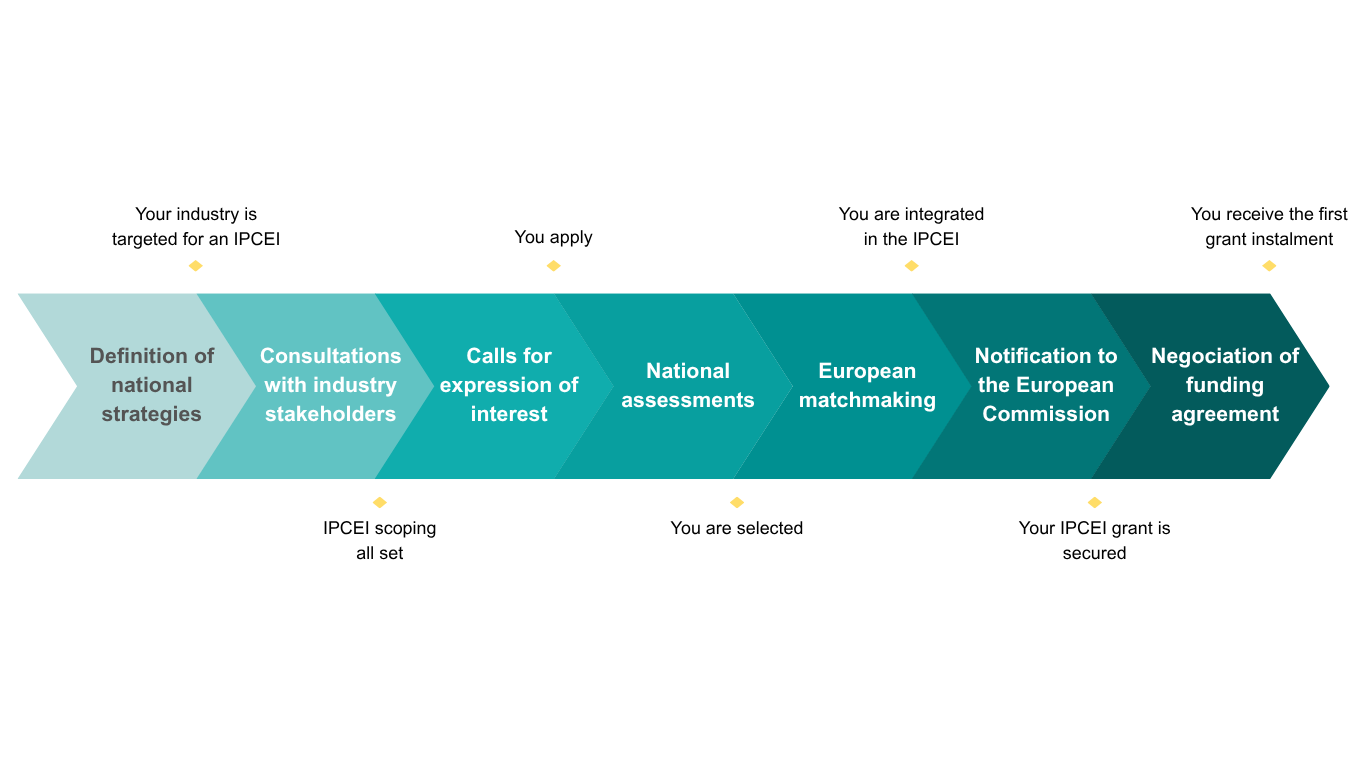
Overview of the IPCEI process: from national strategies to European coordination and pre-notification
What are the eligibility criteria for IPCEI Critical Raw Materials projects?
As with any IPCEI, projects must demonstrate in particular:
- a major innovation, going beyond the global state of the art,
- the existence of one or more market failures justifying the aid,
- a high level of technological, industrial or financial risk,
- effective cross-border cooperation,
- a clear contribution to an integrated project of common European interest,
- significant diffusion effects benefiting the European ecosystem,
- the necessity and proportionality of the aid,
- an absence of any major distortion of competition and trade.
In the case of the IPCEI CRM, projects will need to demonstrate their contribution to the sustainable securing of European supply chains for critical raw materials, to the development of innovative technologies and to the improvement of the circularity of industrial value chains.
They will also need to be consistent with the European objectives relating to the extraction, processing, recycling and diversification of critical raw material supplies.
How does european economics support IPCEI CRM project developers?
european economics supports IPCEI CRM project promoters throughout the project life cycle, from the design and project-building phase through the national consultation and call for projects, up to the compatibility decision of the European Commission:
- the strategic positioning of the project within the European critical raw materials value chain,
- the demonstration of eligibility against the IPCEI criteria,
- the modelling, securing and optimisation of the funding gap and of the grant application,
- the preparation of national application files,
- the preparation of the pre-notification and notification deliverables,
- support up to the compatibility decision of the European Commission, including responding to all of its questionnaires (more than 100 questions for each file).
Since 2018, european economics has supported 151 projects across 14 IPCEIs in 13 Member States, helping to secure 16 billion euros of State aid approved by the European Commission. In the IPCEIs already approved, the companies supported by european economics obtained an average aid amount of 169 million euros per project, compared with an average of 81 million euros for other beneficiaries, a multiplier of 2.1.
european economics has a 100% success rate in individual notification procedures conducted before the European Commission, and an 85% success rate for applications to national calls for expressions of interest launched since 2025.
The major added value of european economics’ support is to enable its clients to plan ahead across the entire process by anticipating the expectations of the Member States and the European Commission, allowing its clients to maximise their chances of success as well as the amount of their grant.
Summary:
- Instrument: IPCEI Critical Raw Materials, at the stage of national calls for expressions of interest.
- Legal basis: Article 107(3)(b) TFEU, 2021 IPCEI Communication.
- Objective: strengthen the competitiveness, industrial resilience, security of supply and strategic autonomy of the European Union across critical raw materials value chains.
- Eligible activities: R&D (from TRL4-5) + First Industrial Deployment (FID, TRL8).
- Process: national consultations and calls for expressions of interest, national pre-selection, European matchmaking, structuring of the integrated project, pre-notification, formal notification, compatibility decision, funding agreements.
- Key challenge for companies: position early, demonstrate a major innovation, build a robust funding gap, identify cross-border partners, structure credible spillovers and demonstrate the project’s contribution to the sustainable securing of critical raw materials in Europe.
Contact us to secure your positioning and maximise your chances of success in the IPCEI CRM.

