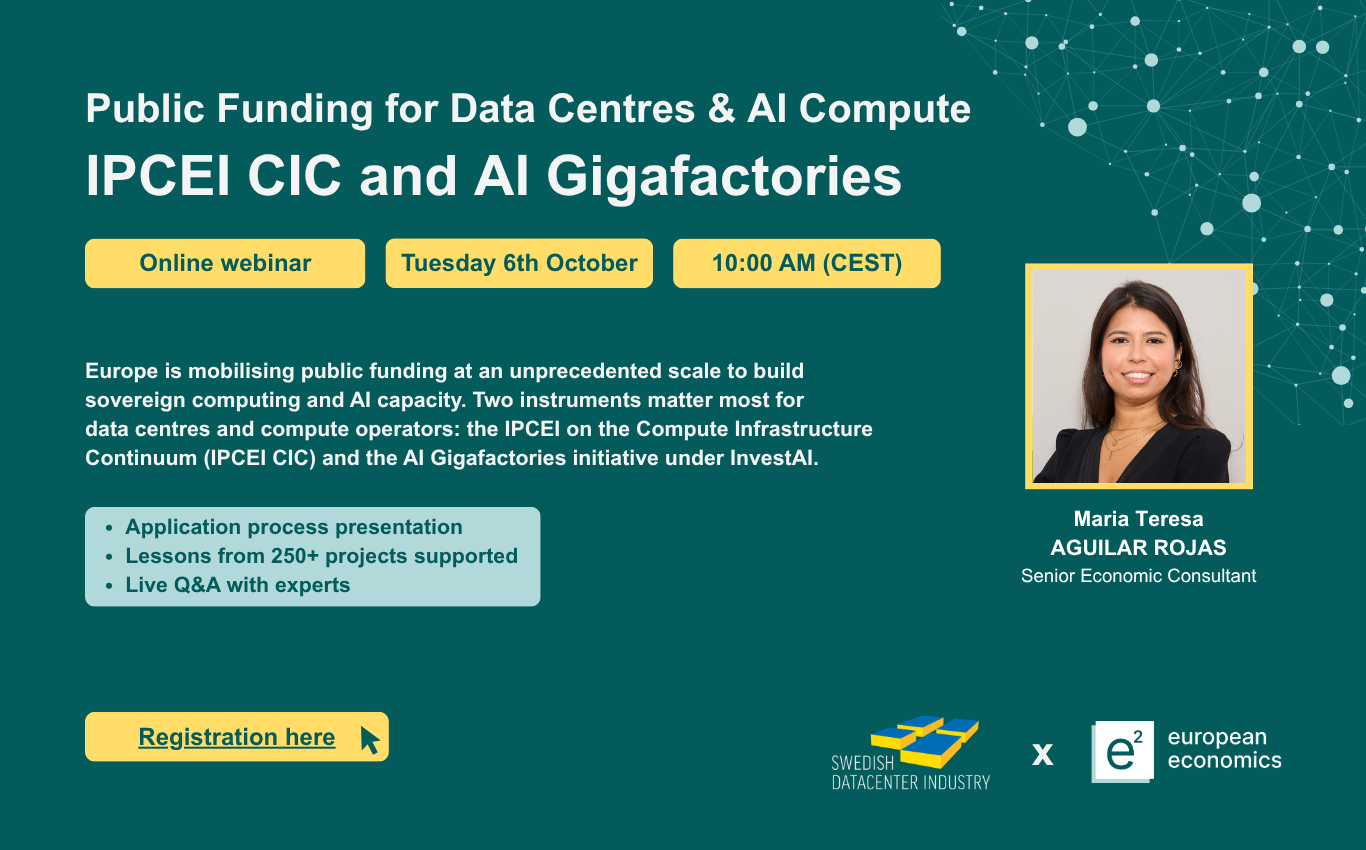
european economics hosts a webinar for SDIA members on public funding for data centres and AI compute
On 6 October 2026, european economics organised, in partnership with the Swedish Datacenter Industry Association (SDIA), a webinar reserved for its members on public funding for data centres and AI compute capacity in Europe. Founded in 2019, SDIA is the leading association for the data centre industry in Sweden. In June 2026, it passed the milestone of 150 member companies, including data centre operators, equipment and service suppliers, consultants, investors, research institutes and end users, both Swedish and international. It advocates for regulation suited to the sector’s challenges, promotes Sweden as a leading location for data centres and provides its members with platforms for collaboration and knowledge-sharing, with a stated goal: building a sustainable, competitive and globally leading industry.
Entitled Public Funding for Data Centres and AI Compute: IPCEI CIC and the AI Gigafactories, the session started from one observation: Europe is entering a new phase of strategic investment in compute, and the question is no longer whether to build capacity, but how to finance, structure and secure approval for it.
Our presentation
Maria Teresa AGUILAR ROJAS
🗓 SDIA Webinar – Tuesday 6 October, 10:00 CEST
Our Senior Economic Consultant presented the two instruments that matter most today for data centre and compute operators: the AI Gigafactories and the IPCEI CIC.
First, the context. Artificial intelligence is the industrial revolution of our time, and it requires infrastructure on an industrial scale. Yet Europe still relies heavily on chips designed and manufactured outside its borders, and on clouds operated by American players. The European response rests on three complementary levers: the Chips Act to reduce dependence on semiconductors, the AI Gigafactories to concentrate very large-scale compute capacity operated by European players, and the IPCEI CIC to distribute compute across regions, cloud and edge.
Next, the AI Gigafactories. Launched under the InvestAI initiative, this programme aims to equip Europe with very large compute facilities for training, fine-tuning and inference of advanced AI models, with capacities that may exceed 100,000 AI processors per facility. The announced public envelope amounts to up to €10 billion, with the ambition of mobilising at least €20 billion in private investment. The European Union contributes through the EuroHPC Joint Undertaking, complemented by the participating Member States, with the remainder borne by the consortia. The current call for tenders, launched on 30 July 2026 and closing on 12 November 2026, involves 18 Member States, including Sweden. It provides for two lots, up to four medium-scale and up to three large-scale gigafactories, with an EU contribution of up to €500 million and €1 billion per project respectively. At the expression of interest stage, 76 proposals covering 60 sites in 16 Member States had been submitted, and around ten bids were already public in June 2026, including a Finnish-Swedish initiative. One key message was highlighted: these calls are won on bankability and the price of compute access, not on infrastructure alone.
Finally, the IPCEI Compute Infrastructure Continuum (CIC). Endorsed by ten Member States on 27 November 2024 and currently in its design phase, it aims to fund the cloud and edge layer below the gigafactories: regional GPU clusters of fewer than 5,000 units, cloud and edge infrastructure for hybrid or latency-sensitive applications, near-premise cloud and connectivity. Sweden is not among the participating States, but Swedish companies can take part as subcontractors or through an entity established in a participating Member State. Eligible costs correspond to capital expenditure on open infrastructure, and State aid can cover up to 100% of these costs depending on the funding gap, with typical support ranging from €50 million to several hundred million euros. The presentation then detailed the six cumulative criteria that every IPCEI file must meet, the stage-gate process leading to notification to the European Commission, required for companies requesting more than €50 million in aid, and the three components of the pre-notification file, with a focus on where files most often get stuck.
The presentation concluded with a positioning grid for SDIA members: the AI Gigafactories for large-scale AI compute capacity projects, the IPCEI CIC for innovative cloud and compute architectures, both instruments, with distinct perimeters, for projects combining capacity and innovative technologies, and a subcontractor role for conventional expansions without a strong European strategic dimension.
At the heart of European compute funding challenges
european economics is a consultancy specialising in public funding for strategic industrial projects in Europe. Since 2009, the firm has supported 257 large industrial projects and helped secure €46 billion in public funding, with a 100% success rate on State aid notifications to the European Commission. Since 2018, it has supported 151 projects within 14 IPCEIs across 13 Member States.
This presentation comes at a timely moment for the industry, with the AI Gigafactories call open until 12 November 2026 and the IPCEI CIC currently being designed.
Let’s keep the conversation going
We would like to thank Ann WINGÅRD, Fredrik LINDAHL, Livia KELLY and the SDIA team for promoting this webinar to their members, as well as all participants.
Are you preparing a data centre or AI compute project and looking to assess your public funding options? Contact us to arrange a meeting!


Discover other articles