european economics invited by BEPA for a Policy Talk on funding the battery value chain
On 22 September 2026, european economics spoke, at the invitation of the Batteries European Partnership Association (BEPA), at a webinar reserved for its members. BEPA is the voice of European research and innovation across the battery value chain. An international non-profit association, it brings together 250 members in 25 countries: start-ups, scale-ups and industrial groups, universities, research and technology organisations and associations. It sets technological priorities, advocates for funding and financing policies and fosters collaboration, with the aim of accelerating research and innovation and their industrialisation for a competitive Europe, building on its experience running Horizon Europe’s Batt4EU partnership.
This webinar is part of BEPA’s Policy Talks series: members-only webinars presenting the European funding instruments available to the battery value chain, whose documentation feeds into the work of the association’s Policy Task Force. Entitled IPCEIs for Batteries: Insights from european economics, the session attracted over 100 registrations from industry, research centres and public institutions across Europe, including cell manufacturers, component suppliers, recycling players and several representatives of the European Commission.
This was european economics’ second intervention for BEPA members. On 28 April 2025, Marc ISABELLE, our CEO and Founder, had delivered a first webinar entitled IPCEIs – A tool for European industrial & innovation leadership!, covering the fundamentals of the instrument, lessons learned from the two Batteries IPCEIs and the requirements of the notification file submitted to the European Commission. The procedural chart prepared by european economics for these Policy Talks also features in the Battery R&I Funding Handbook published by BEPA in 2025.
Our intervention
Hedi BAIRAM
🗓 BEPA Policy Talk – Tuesday 22 September, 12:00
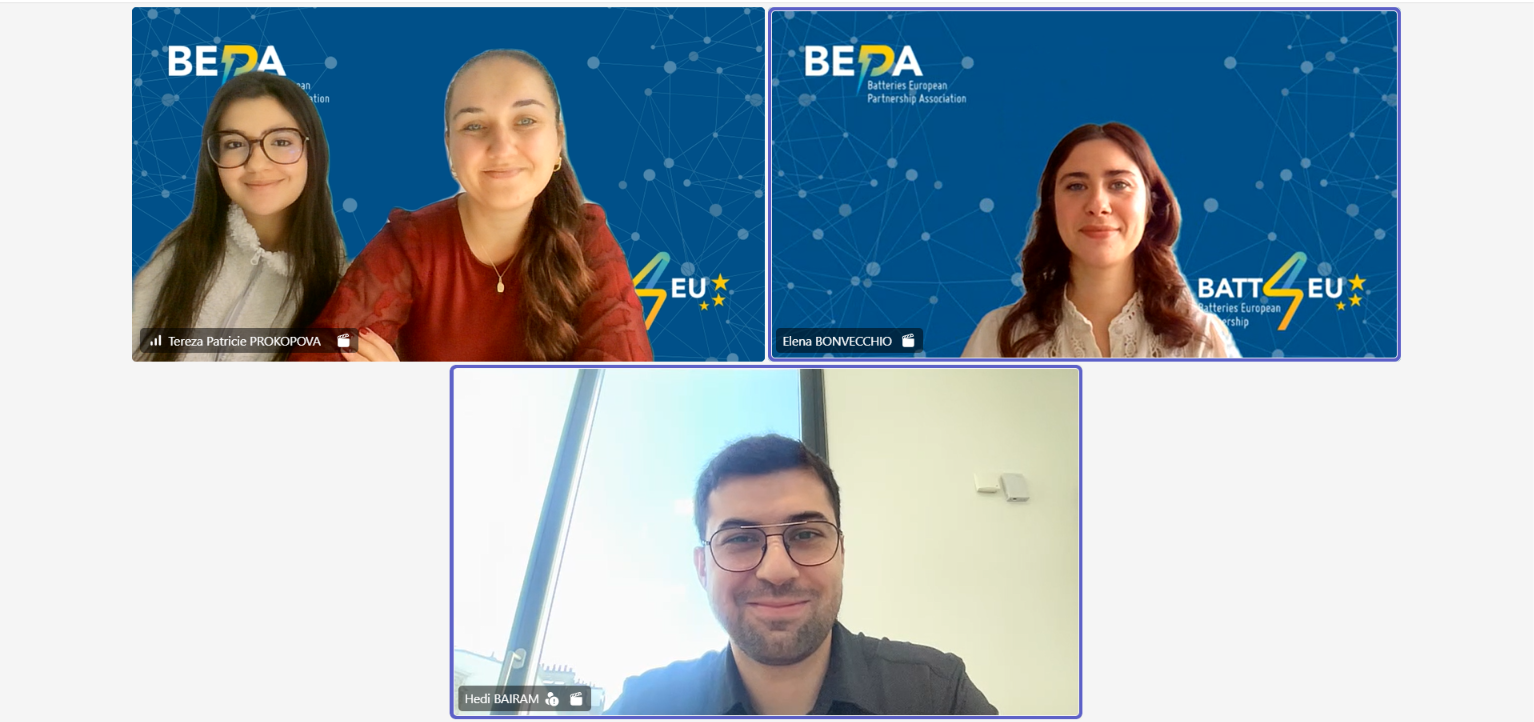
Following a short introduction by Elena BONVECCHIO, Policy Officer at BEPA, our Project Director & Manager led the entire session. An economist specialising in the public funding of large-scale industrial and innovation projects, Hedi BAIRAM advises on strategic, capital-intensive investments within complex State aid frameworks. His thirty-minute presentation offered a practical reading of the public funding available to the battery value chain over the next twelve months, followed by a Q&A session with participants.
Three instruments were reviewed. First, the IPCEIs, a State aid authorisation route rather than an EU funding programme, with two projects open to the sector: the IPCEI Critical Raw Materials (CRM), focused on extraction, anthropogenic deposits and, above all, processing, metallurgy and recycling, and the IPCEI Circular Advanced Materials (CAM), dedicated to materials with new properties incorporating at least one circularity strategy. CAM is moving into national assessment, while CRM is only now opening its calls for expressions of interest. Second, the Innovation Fund, whose IF25 call attracted six times more demand than its budget, making the second-chance levers of the STEP Seal and the Grants-as-a-Service mechanism decisive, and whose IF26 call will include critical raw materials projects. Third, the Battery Booster Facility and the CISAF: the former offers EUR 1.5 billion in interest-free loans to first cell plants in their ramp-up phase, the latter allows Member States to support manufacturing capacity based on proven technologies.
The intervention concluded with a decision grid by project type, IPCEI, Innovation Fund, CISAF or Battery Booster, and a reminder of the cumulation rules between these schemes.
At the heart of funding challenges for the battery value chain
european economics is a consultancy specialising in the public funding of strategic industrial projects in Europe. Since 2018, the firm has supported 151 projects across 14 IPCEIs in 13 Member States, helping to secure EUR 16 billion in State aid approved by the European Commission. Across all instruments, the firm has supported 25 projects in the battery value chain.
This intervention comes at a time of renewal for the public instruments dedicated to batteries, with the opening of the CAM and CRM IPCEIs, the arrival of critical raw materials in the Innovation Fund and the launch of the Battery Booster by the European Commission.
Let’s continue the conversation
We thank BEPA and its team for their invitation and the quality of the exchanges.
Are you preparing a project in the battery value chain and would like to assess your public funding options? Contact us to arrange a meeting!