
IPCEI Quantum
IPCEI on quantum technologies: design phase, national consultations and European structuring.
A strategic opportunity for European players in quantum technologies
At its high-level meeting of 24 November 2025, the JEF-IPCEI (Joint European Forum for IPCEI) decided to devote its 2026 identification work to quantum technologies. A working group bringing together 10 Member States was launched in the second quarter of 2026 to assess the relevance of a new Important Project of Common European Interest (IPCEI) in this field: the IPCEI Quantum.
At this stage, the IPCEI Quantum is in the identification phase: it has not yet been endorsed by the Member States and does not appear in the European Commission’s Design Support Hub, which lists the nine IPCEIs currently in the design phase. No national call for expressions of interest has therefore been published to date.
This early stage represents, for companies in the quantum sector, an opportunity to anticipate and to prepare strategically. The challenge is to be ready to demonstrate the structuring elements of an IPCEI project: a highly innovative nature, the existence of a funding gap (necessity and proportionality of the aid), effective cross-border cooperation and commitments guaranteeing spillover effects for the benefit of the European ecosystem.
Contents:
- What is the IPCEI Quantum?
- Why an IPCEI dedicated to quantum technologies at European level?
- What are the technological domains covered by the IPCEI Quantum?
- What is the application process for projects under the IPCEI Quantum?
- What are the eligibility criteria for IPCEI projects dedicated to quantum technologies?
- How does european economics support IPCEI project developers in quantum?
- Summary
What is the IPCEI Quantum?
IPCEI: a State aid framework for important projects of common European interest
An IPCEI, or Important Project of Common European Interest, is a regulatory framework that allows several Member States to support, by means of coordinated State aid, projects considered to be of strategic importance for the European Union. These projects must contribute to clearly identified European objectives, be structured in an integrated manner across at least four Member States and generate positive spillovers throughout the EU economy, beyond the aid beneficiaries alone. The European Commission assesses them under Article 107(3)(b) of the Treaty on the Functioning of the European Union (TFEU) and the 2021 IPCEI Communication.
An IPCEI is not a standalone project. It is a large, integrated pan-European project bringing together several dozen complementary individual projects, carried out by companies located in different Member States, around a shared technological and industrial roadmap.
The IPCEI Quantum falls within this general framework. Its precise scope, its structure and its coordinating Member State(s) will be defined by the participating Member States at the end of the identification phase, and then during the design phase.
Funded activities: R&D&I and First Industrial Deployment
Under the IPCEI framework, the activities eligible for support cover:
- research, development and innovation activities, from TRL4-5, provided that projects go beyond the global state of the art,
- pilots, demonstrators or “first-of-a-kind” equipment (TRL7),
- the First Industrial Deployment (FID) phase, corresponding to the transition from TRL7 to TRL8, excluding mass production and commercial activities (European Commission, 2026).
Eligible costs may include R&D and FID operating expenditure as well as the depreciation of dedicated assets over the duration of the project.
Why an IPCEI dedicated to quantum technologies at European level?
Industrial and sovereignty challenges identified at European level
The European Union has recognised strengths in quantum research (scientific excellence, a deep talent pool, a strong start-up base), but it struggles to convert this lead into industrial outcomes and continues to face fragmentation of strategies and roadmaps across Member States (European Commission, 2025). European quantum companies capture only around 5% of global private funding in the sector, whose global value the Commission estimates at more than 155 billion euros by 2040 (European Commission, 2025). These technologies also have strong dual-use potential (security and defence).
Under the IPCEI framework, these findings point to market failures typical of breakthrough technologies: high capital intensity, a long path to profitability, high technological risk and the difficulty of financing, through the market alone, the transition from research to first industrial deployment.
A strategic context structured by the Quantum Europe Strategy
The IPCEI Quantum forms part of the Quantum Europe Strategy, adopted by the European Commission on 2 July 2025, which aims to make Europe a global leader in quantum by 2030. It is organised around five areas for action: research and innovation, quantum infrastructures, strengthening the ecosystem, space and dual-use technologies, and skills.
The actions announced include the launch of a Quantum Europe Research and Innovation Initiative (a joint effort by the EU and the Member States), the establishment of a quantum design facility and six quantum chips pilot lines, the launch of a pilot facility for the European Quantum Internet and the creation in 2026 of a European Quantum Skills Academy (European Commission, 2025).
The Quantum Act: a legislative proposal in preparation
The Strategy is to be followed by a Quantum Act proposal, announced for 2026. According to the European Commission, this Act will pursue three objectives: boosting research and innovation, scaling up industrial capacity (pilot lines and design facility) and reinforcing supply chain resilience and governance. It is intended to complement the Chips Act, the EuroHPC Joint Undertaking and IRIS² (European Commission, 2025). A call for evidence was opened on 29 October 2025 to inform its impact assessment.
Links with existing European instruments
The IPCEI Quantum would be articulated with several European instruments already under way:
- the EuroHPC Joint Undertaking, whose amended Regulation, in force since 20 January 2026, extends its mandate to quantum technologies (European Commission, 2026). In 2022, EuroHPC selected six sites (Czechia, Germany, Spain, France, Italy and Poland) to host the first European quantum computers, coupled with supercomputers; the first systems were inaugurated in Poznań (June 2025), Ostrava (September 2025) and Munich (February 2026) (European Commission, 2026);
- the Chips Joint Undertaking (Chips Act), which on 28 April 2025 selected six consortia for quantum chip pilot lines covering design, microfabrication and testing; six framework partnership agreements have been signed, with expected EU funding of 150 million euros, matched by the participating States (European Commission, 2026);
- the Quantum Technologies Flagship, a research initiative launched in 2018 with an EU budget of 1 billion euros, and the EuroQCI quantum communication infrastructure initiative, which all 27 Member States have joined (European Commission, 2026).
Continuity with previous IPCEIs
Quantum is not absent from the IPCEIs already approved or in preparation. The IPCEI Microelectronics and Communication Technologies (ME/CT), approved in 2023, contributes in particular to advances in quantum (European Commission, 2023). The IPCEI Advanced Semiconductor Technologies covers quantum photonics and quantum sensors.
Where research programmes (Horizon Europe, the Flagship) and shared infrastructures (EuroHPC, Chips JU pilot lines) cover the upstream stages and pooled capacities, a dedicated IPCEI could provide the State aid lever enabling companies to finance the breakthrough R&D and first industrial deployment of their own quantum technologies.
What are the technological domains covered by the IPCEI Quantum?
For guidance, the three main application domains identified by the European Commission, together with the industrial building block of quantum chips, constitute the most likely frame of reference for the discussions (European Commission, 2026).
Quantum computing and simulation
Quantum processors and computers, hybrid architectures coupling quantum computing with high-performance computing, software and algorithms, with target applications in materials and molecular simulation, optimisation and drug discovery.
Quantum communication
Quantum key distribution technologies and secure communication networks, linked to the EuroQCI infrastructure and the European Quantum Internet pilot facility announced in the Quantum Europe Strategy.
Quantum sensing and metrology
Sensors offering performance superior to their classical equivalents, notably quantum gravimeters and positioning, navigation and timing (PNT) systems, with applications in Earth observation, geophysics and the security and defence fields.
Quantum chips and enabling technologies
Design, fabrication and testing of quantum chips, in conjunction with the Chips Joint Undertaking pilot lines and the future quantum design facility, together with the enabling building blocks required for industrialisation (control electronics, cryogenics, photonics, materials).
The scope adopted, the workstreams and any coordinating Member States will be communicated by the participating Member States once the project has been endorsed.
What is the application process for projects under the IPCEI Quantum?
As with other IPCEIs, the process is coordinated at European level but implemented in a decentralised manner by the Member States, under the responsibility of one or more coordinating countries.
Calls for expressions of interest and national pre-selection
Entry into an IPCEI takes place at national level. Each participating Member State organises its own consultations, calls for expressions of interest (CEIs) and calls for projects in order to identify the companies likely to contribute to the future integrated European project.
This stage is decisive: only projects pre-selected at national level can then take part in the European structuring, the matchmaking and the preparation of the pre-notification files.
Indicative timetable for national consultations (IPCEI Quantum)
| Member State | Closing date |
|---|---|
| Italy | 6 September 2026* |
*This is not a formal call for expressions of interest but an information-gathering exercise conducted by the Member State.
Project structuring and cross-border matchmaking
An IPCEI cannot consist of a collection of isolated national projects. It must be structured as a large, integrated pan-European project involving at least four Member States.
The matchmaking phase, organised under the aegis of the coordinating Member State, makes it possible to:
- identify complementary partners in different Member States,
- align technological and industrial roadmaps,
- structure R&D and first industrial deployment collaborations,
- strengthen the expected diffusion and spillover effects.
Pre-notification to the European Commission (DG Competition)
The pre-notification phase allows the European Commission, and in particular DG Competition, to examine upstream the compatibility of the envisaged aid with European State aid rules.
It is based on three structuring deliverables:
- the Project Portfolio, which demonstrates that the project and its public funding satisfy all the eligibility and compatibility criteria of an IPCEI (innovative nature, market failures, spillovers, necessity and proportionality, absence of any major distortion of competition),
- the Funding Gap, a business plan identifying the eligible costs (R&D and FID) and the non-eligible costs, and calculating the amount of aid required,
- the Prodcom market analysis, identifying the markets concerned, the competitors, the current and future market shares, and the risks of distortion of competition and trade.
The European Commission sends companies several questionnaires (Requests for Information) throughout this phase, which lasts several months. The quality and consistency of the deliverables are decisive: in the most recent IPCEIs, around 40% of companies had to withdraw from participation following this assessment.
Formal notification
Once the European Commission considers that it has all the information required, it invites the Member States to formally notify the envisaged aid. It assesses their compatibility with Article 107(3)(b) TFEU and the 2021 IPCEI Communication, balancing the positive and negative economic effects of the aid.
Compatibility decision and signature of the funding agreement
At the end of the notification phase, which lasts a maximum of two months, the European Commission adopts a compatibility decision legally authorising the Member States to grant the aid. No aid may be paid before this decision has been adopted.
The national authorities and the beneficiary companies then negotiate and sign the funding agreements, which define the scope of the funded project, the arrangements for granting the aid, the milestones and the reporting obligations.
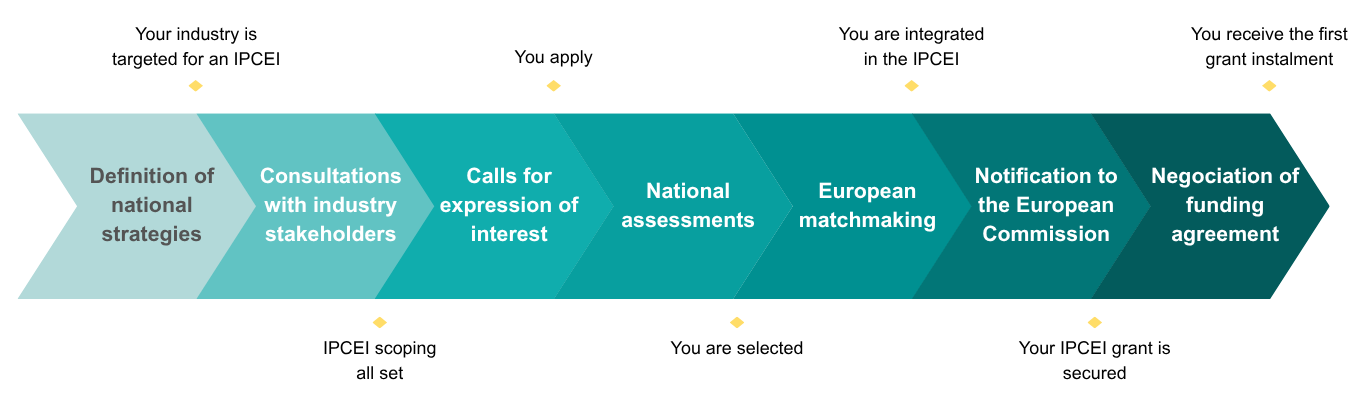
Overview of the IPCEI process: from national strategies to European coordination and pre-notification to the Commission
What are the eligibility criteria for IPCEI projects dedicated to quantum technologies?
As with any IPCEI, projects must demonstrate in particular:
- a major innovation, going beyond the global state of the art,
- the existence of one or more market failures justifying the aid, in light of the principles of necessity and proportionality,
- a high level of technological, industrial or financial risk,
- effective cross-border cooperation, as part of an integrated project at European level,
- clear commitments to disseminate results (spillovers) for the benefit of the European ecosystem, beyond the direct beneficiaries,
- an absence of any major distortion of competition and trade.
In the case of the IPCEI Quantum, projects will most likely need to demonstrate their contribution to the priorities set by the Quantum Europe Strategy: the transition from research to industrial applications, the securing of supply chains for quantum components and the strengthening of European technological sovereignty. The specific criteria will be set out by the participating Member States during the design phase.
How does european economics support IPCEI project developers in quantum?
european economics supports IPCEI Quantum project promoters throughout the project life cycle, from the strategic preparation phase ahead of the national calls up to the compatibility decision of the European Commission:
- the strategic positioning of the project within the European quantum technologies value chain,
- the demonstration of eligibility against the IPCEI criteria (innovation beyond the state of the art, funding gap, cross-border cooperation, spillovers, absence of distortion of competition),
- the modelling, securing and optimisation of the funding gap and of the grant application,
- the preparation of national application files,
- the preparation of the pre-notification and notification deliverables,
- support up to the compatibility decision of the European Commission, including responding to all of its questionnaires.
Since 2018, european economics has supported 151 projects across 14 IPCEIs in 13 Member States, helping to secure 16 billion euros of State aid approved by the European Commission. In the IPCEIs already approved, the companies supported by european economics obtained an average aid amount of 169 million euros per project, compared with an average of 81 million euros for other beneficiaries, a multiplier of 2.1.
european economics has a 100% success rate in individual notification procedures conducted before the European Commission, and an 85% success rate for applications to national calls for expressions of interest launched since 2025 under the new IPCEIs.
In the specific case of the IPCEI Quantum, our support aims to enable companies to plan ahead across the entire process from the identification phase onwards, anticipating the expectations of the Member States and the European Commission, so as to be ready as soon as the national calls open.
Summary:
- Instrument: IPCEI Quantum, in the identification phase within the JEF-IPCEI (“Quantum Technologies” working group, 10 Member States, launched in the second quarter of 2026).
- Legal basis: Article 107(3)(b) TFEU, 2021 IPCEI Communication.
- Objective: accelerate the transition from European quantum research to first industrial deployment, and strengthen technological sovereignty and supply chain resilience, in line with the Quantum Europe Strategy.
- Eligible activities: R&D (from TRL4-5) + First Industrial Deployment (FID, TRL8).
- Process: identification within the JEF-IPCEI, endorsement by the Member States, design phase (national calls for expressions of interest, pre-selection, European matchmaking), pre-notification, formal notification, compatibility decision, funding agreements.
- Key challenge for companies: position now, ahead of the national calls, and prepare a project that meets IPCEI requirements: innovation beyond the state of the art, a robust funding gap, identified cross-border partners, credible spillovers and a demonstrated contribution to European quantum priorities.
Contact us to secure your positioning and maximise your chances of success in the IPCEI Quantum.

