european economics at the ISIG MEMS & Sensors World Summit EU 2026
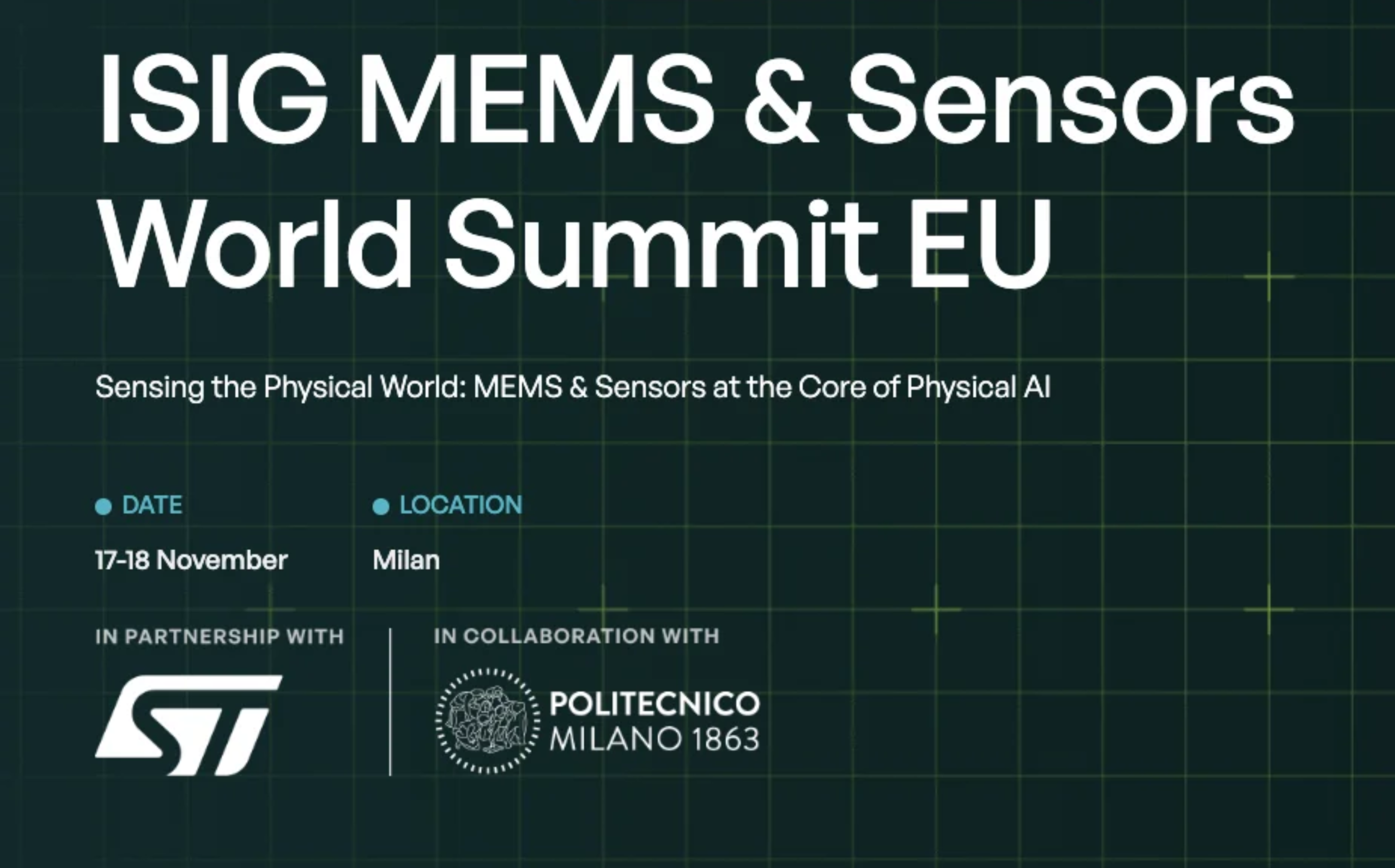
european economics took part in the ISIG MEMS & Sensors World Summit EU 2026 (MSWS EU 2026), organised by the International Semiconductor Industry Group (ISIG) on 17 and 18 November 2026 in Milan, at Politecnico di Milano, Campus Bovisa.
Held under the theme “Sensing the Physical World: MEMS & Sensors at the Core of Physical AI”, the summit brought together industry leaders, researchers and investors from the MEMS and sensors ecosystem. The programme covered sensing systems at the heart of robotics and humanoids, seeing and processing the physical world in the AI era, scaling Europe’s deeptech from lab to market, and market outlook and funding opportunities. Participants were also able to visit PoliFab, the micro and nanofabrication cleanroom of Politecnico di Milano, on the Leonardo Campus.
Our session
Marc ISABELLE, Founder and CEO of european economics, spoke on 17 November in the “Market Outlook & Funding Opportunities” session, on Navigating Public Funding Opportunities in the EU for the Semiconductor Industry.
His starting point: European public money only goes to projects serving the Union’s strategic goals, and semiconductors serve all three. Decarbonisation, with silicon carbide and gallium nitride power chips electrifying cars, grids and industry. Competitiveness, as the sector is the key enabling technology of artificial intelligence and one of the most R&D-intensive industries. Resilience, with the Chips Act target of restoring 20% of world production in Europe by 2030. The result is public funding available at every step of the value chain, from research through to manufacturing.
Two instruments were set out in detail. First, IPCEIs, which fund very large cross-border collaborative projects targeting innovation beyond the global state of the art, with eligible costs running up to first industrial deployment, aid intensity of up to 100% of eligible costs and notification to the Commission above 50 million euros of aid. Second, pillar 2 of the European Chips Act, a State aid exemption introduced in 2023, which supports new or extended production capacity that is first-of-a-kind in the Union, on the basis of capital expenditure, with notification to the Commission from the first euro of aid.
Marc also highlighted what changes with the forthcoming IPCEI Advanced Semiconductor Technologies (IPCEI AST): a scope widened to the whole value chain, including equipment, EDA and materials, and to three new fields, AI chips, photonics, chiplets and packaging, alongside capped aid intensities and a tighter timetable. As for the Chips Act 2.0, proposed by the Commission in June 2026, it promises European co-investment on top of national aid, with no budget settled before the 2028-2034 multiannual financial framework. The central message of the session: design the project and its funding route together, from day one, to maximise funding and control the risk of rejection.
Our track record in microelectronics
european economics has supported 55 strategic projects in the microelectronics industry, securing 12 billion euros in public funding, working with fabless companies, materials and wafer manufacturers, IDMs, foundries, equipment manufacturers and OEMs. The firm is currently working on 17 IPCEI AST projects across 5 Member States.
Let’s discuss your projects
Preparing a project in MEMS, sensors or strategic industrial technologies and looking to identify the public funding available? Get in touch.


Discover other articles