

Contents:
- What is the InvestAI initiative?
- AI gigafactories: definition and strategic importance for the European Union
- AI Factories vs AI gigafactories: what are the differences?
- How does InvestAI finance AI gigafactories?
- Other European funding instruments, including the IPCEI on computing infrastructure
- How european economics supports clients
What is the InvestAI initiative?
Announced during the Paris “AI Action Summit” in February 2025, the “InvestAI” initiative aims at mobilising around €200 billion of investment in Artificial Intelligence across the EU over the medium to long term ( ~ up to 2030) (European Commission, 2025).
The goals of this initiative are to strengthen Europe’s AI ecosystem and to ensure that companies of all sizes can access the large-scale computing infrastructure needed to develop advanced AI models. Such infrastructure is necessary to enable the collaborative development of complex AI models that ensure compliance with the EU regulations on data protection and on the use of Artificial Intelligence. InvestAI will stimulate research and innovation, and strengthen Europe’s competitiveness and ambition to become an “AI continent”.
InvestAI proposes several interrelated initiatives:
- The establishment of a large-scale IT infrastructure dedicated to AI;
- The access to high-quality and secure data;
- The promotion of AI in strategic sectors such as clean energy technology, industrial manufacturing, advanced microelectronics and medical and biological technologies;
- The strengthening of skills and talent in the field of AI;
- The simplification of the implementation of AI regulations;
- The creation of 4 to 5 AI Gigafactories to train complex AI models on an unprecedented scale (€20 Billion in InvestAI) by pooling public and private investment.
What are AI Gigafactories and what is their importance for the EU?
Al Gigafactories serve as large-scale computing and data infrastructures, specifically designed to enable the development of next-generation AI models and applications at hyperscale. They will provide critical support for Al uptake across key strategic sectors and for cutting-edge research and science.
As defined in Article 2(3c) of Council Regulation (EU) 2026/150 amending Regulation (EU) 2021/1173, an “AI gigafactory” is defined as follows:
“State-of-the-art large-scale facility with sufficient capacity to handle the complete lifecycle, from development to large-scale inference, of very large AI models and applications, providing a supercomputing service infrastructure which is composed of AI-optimised computing capacity, a supporting data centre infrastructure including high-capacity storage and networking, dedicated secure cloud user access environments, and specialised secure AI-oriented support services for its advanced operations, all of which are supported by an environmentally sustainable infrastructure, in particular for energy and water supply system.”
How is an AI Gigafactory different from an AI Factory?
AI Gigafactories and AI Factories are key instruments of the EU Commission’s strategy to support the uptake of AI in Europe (European Commission, 2025). However, there are some important distinctions between these two infrastructures.
AI Factories can be considered a precursor of the InvestAI initiative. In 2024 and 2025, a total of 13 AI factories have been selected for construction and implementation in 7 European countries. These facilities entered an implementation and ramp-up phase during 2025, with progressive deployment and operationalisation expected through 2026, enabling access to AI computing resources for research, startups and industry.
The upcoming AI Gigafactories will build on the AI Factories model, but they will have a significantly larger compute capacity to develop and train next-generation AI models at much higher scale. The table below outlines the major differences between AI Gigafactories and AI factories:
| Dimension | AI Gigafactories | AI Factories |
|---|---|---|
| Primary function | Hyperscale training and deployment of next-generation AI models | Development and application of generative and trustworthy AI |
| Compute capacity | > 100,000 advanced AI chips per site | ~ 25,000 AI chips per site |
| Infrastructure type | Hyperscale, energy-efficient data centres with integrated storage | AI-optimised supercomputers and data centres |
| Indicative investment | EUR 3–5 billion per facility | A total of EUR 2.6 billion for 13 facilities |
| Ecosystem positioning | Pan-European compute backbone for research and industry conceived as public-private partnerships | Regional or national AI compute hubs enabling innovation ecosystems for SMEs, startups and researchers |
Comparison between AI Factories and Gigafactories (European Investment Bank, 2025; European Commission, 2025; EuroHPC JU, 2025; European Commission, 2025).
How will the InvestAI initiative contribute to the building of AI Gigafactories in the EU?
As reported above, €20 billion of the InvestAI program will be dedicated to the construction of 4 to 5 AI Gigafactories in the European Union, with a total budget of €3 to 5 Billion each. The overarching objective is to reduce the substantial economic and business risks of AI Gigafactories and attract private investment that would not materialise without these grants. By anchoring these AI Gigafactories on European soil, InvestAI will enable sovereign access to high-performance computing capabilities and reduce the dependence of European players on non-European suppliers, thereby strengthening Europe’s long-term competitiveness and autonomy. Around 65-70% of the funding is expected to come from private investors, with the remaining 30-35% from public sources (euronews, 2025 and EuroHPC, 2025).
As a first implementation step for the AI Gigafactory call, the European Commission launched an informal call for expressions of interest on 9 April 2025, with a deadline on 20 June 2025. This call attracted a total of 76 submissions, representing more than €230 billion in total proposed investments. Although the Commission has not disclosed participating countries and consortia, public releases enabled to identify that the 76 applications were submitted from 60 different sites of 16 Member States, including France, Germany, Spain, Portugal, Netherlands, Poland, Italy, Finland, Austria, Czech Republic, Romania, Lithuania, Latvia and Estonia (European Commission, 2025).
A further milestone was reached on 4 December 2025 with the signing of a cooperation protocol between the European Investment Bank and the European Commission. In parallel, the Commission announced that the formal call for expressions of interest, initially expected in December 2025, has been postponed and is now planned for the beginning of 2026 (TelcoTitans, 2025).
On 16th January 2026, the Council of the EU adopted an amendment to Council Regulation (EU) 2021/1173 of 13 July 2021 on establishing the European High Performance Computing Joint Undertaking. This amendment strengthened the mandate of the EuroHPC JU explicitly including the deployment of AI gigafactories that were absent from the initial regulatory framework. It also clarified that the financial contribution of the EU will amount to 17 % of the capital expenditure (CAPEX) investments in the overall computing infrastructure of the AI gigafactory.
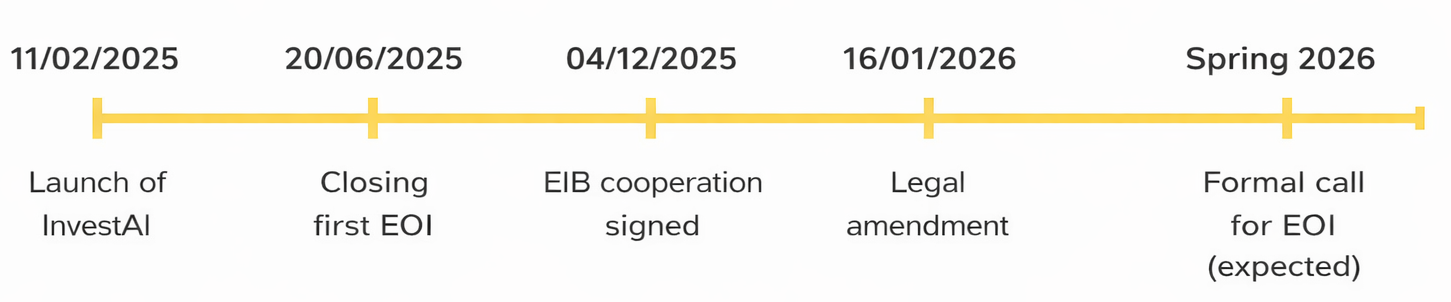
Timeline of the AI Gigafactories call
Additional related funding opportunities – IPCEI on Compute Infrastructure Continuum
As outlined above, the computing capacity of AI Gigafactories is approximately 100,000 AI chips per site, while that of AI Factories is around 25,000 AI chips per site.
For high-performance computing facilities of smaller size, another possible public funding instrument is the Important Projects of Common European Interest (IPCEI) on Compute Infrastructure Continuum.
The IPCEI on Compute Infrastructure Continuum (CIC) will cover regional GPU clusters acting as satellites to AI Gigafactories for data curation and the training, adaptation and evaluation of specialised AI models. It will also include integrated cloud-edge and near-premise cloud infrastructures for latency-critical and hybrid public-private cloud use cases, supported by advanced edge-cloud connectivity enabling secure, scalable, low-latency and high-bandwidth applications. Large HPC clusters (>5,000 GPUs) will be out of the scope : indeed, they are expected to fit the AI Factory/Gigafactory framework (Federal Ministry for Economic Affairs and Energy, 2025).
The figure below summarizes the foreseen scope of the IPCEI on CIC.
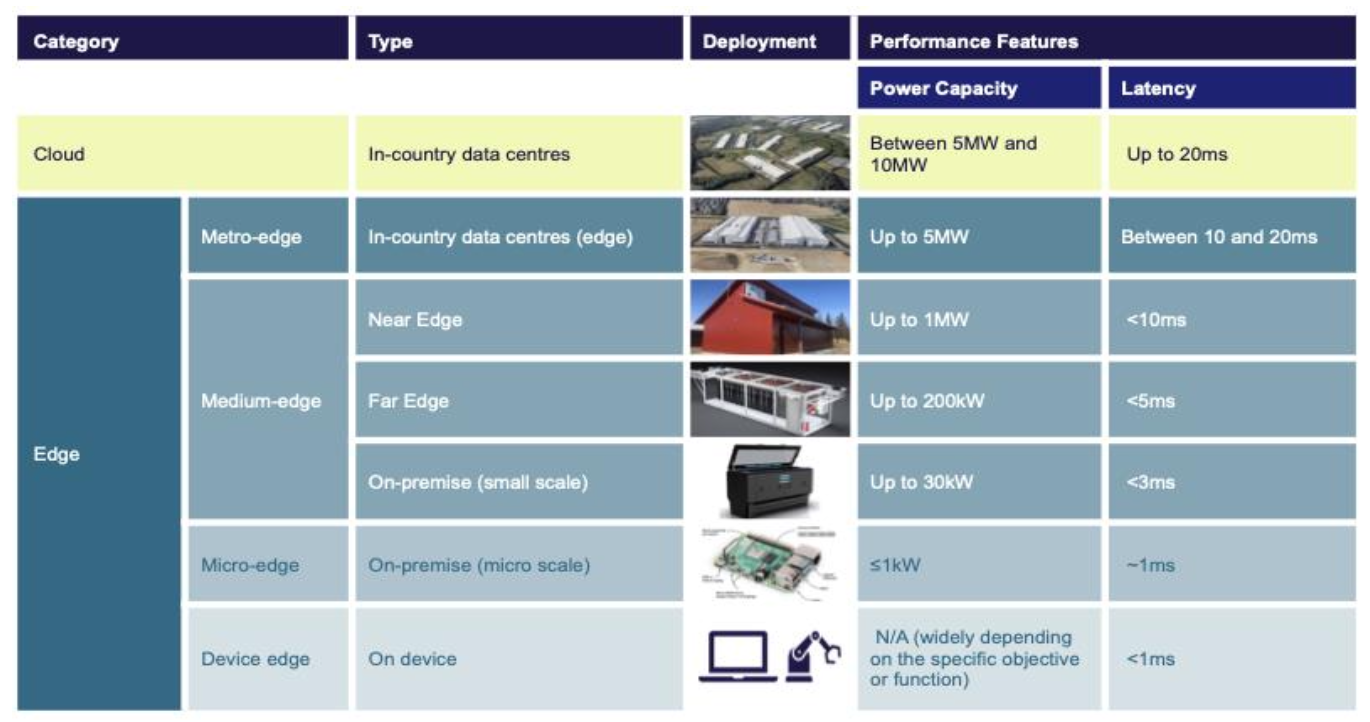
Expected KPIs of infrastructure in the scope of the IPCEI CIC (European Commission (DG CONNECT), Interim Report 3 – Edge Computing Taxonomy and Characterisation, 2025).
For more information on the IPCEIs, please refer to european economics’ articles IPCEI and IPCEI: The EU’s Strategic Compass for Industrial Competitiveness and Resilience.
How can european economics support its clients in the AI Gigafactories call and related initiatives?
Since 2009, european economics has supported 203 companies secure public (national or EU) funding and State aid across 250 high-stake projects in sectors of strategic importance for the EU. We assist clients in engineering projects that are fully compliant with the reference regulation, optimising funding, preparing national application files as well as performing State aid notifications to the European Commission, all the way to final approval. This includes seven projects on artificial intelligence and cloud computing starting in 2021.
Contact us to identify the right funding instrument for your AI infrastructure project and build a strong application.
Article written by the consulting team at european economics.