IPCEI Conference 2026: structuring the second wave of European industrial projects
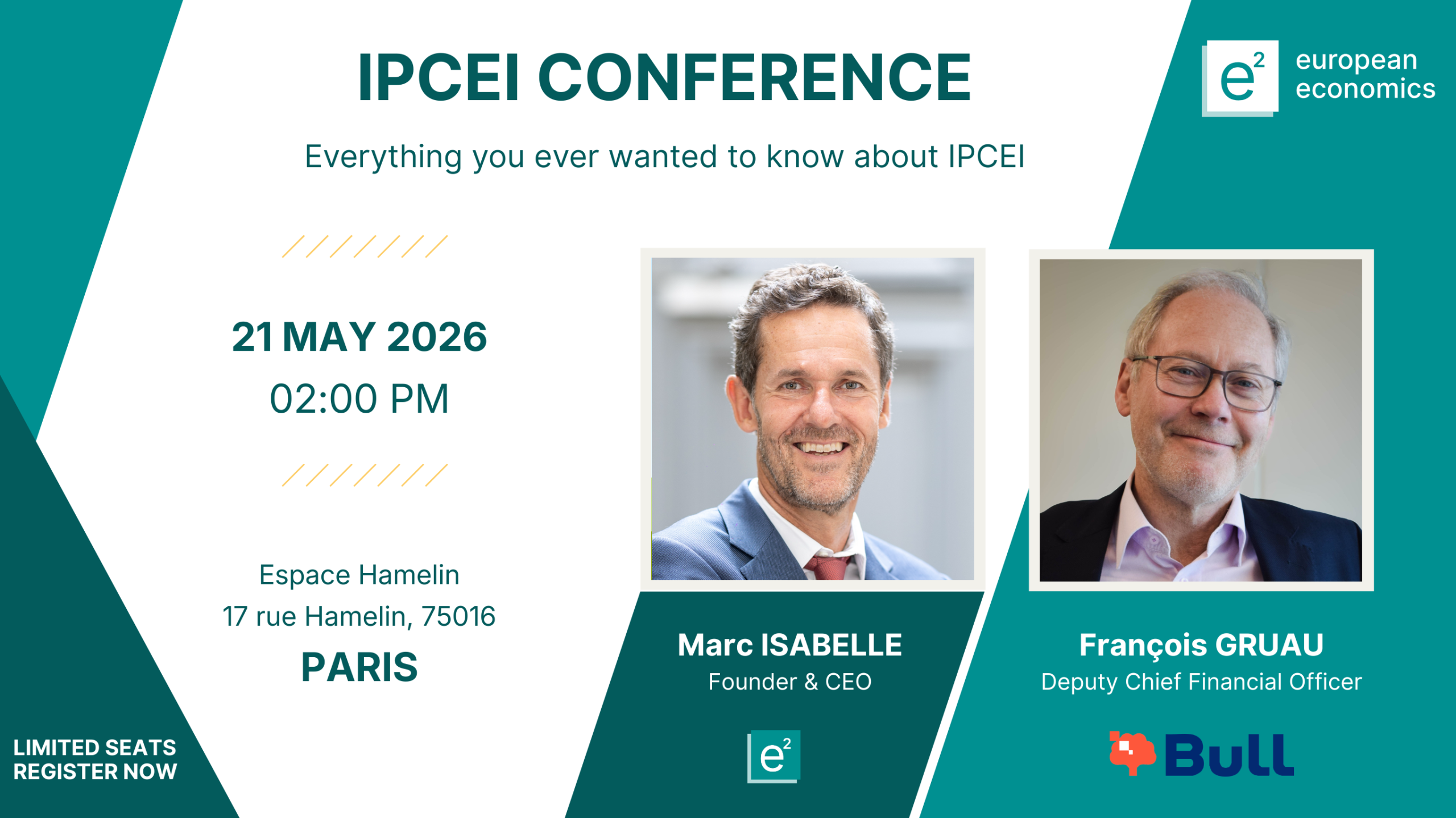
On 21 May 2026, european economics brought together industrial, financial and institutional stakeholders in Paris for its conference dedicated to Important Projects of Common European Interest (IPCEI).
Against a backdrop marked by the emergence of a new wave of IPCEI programmes in Europe, this edition provided a concrete, structured and operational understanding of the scheme, while shedding light on the key success factors through an industrial case study.
IPCEI and European industrial policy: a central pillar in the face of strategic dependencies
Opening the IPCEI conference, Narjiss HADDAOUI, Managing Director and Partner at european economics, set out how Europe is reconfiguring its industrial policy to respond to a rapidly evolving geopolitical and economic landscape that is revealing new strategic dependencies.
In this context, IPCEIs are establishing themselves as a central pillar of European industrial strategy, alongside other major funding initiatives such as InvestAI, the EU Chips Act 2.0 and the forthcoming European Competitiveness Fund.
These instruments reflect a deliberate paradigm shift: the move from an economy founded on free trade to a coordinated European industrial policy, underpinned by reinforced public-private funding and joint initiatives between Member States to secure strategic value chains.
Building an IPCEI project: from the regulatory framework to implementation
Marc ISABELLE, President and Founder of european economics, then offered an overview of the IPCEI framework, from its regulatory foundations to the various stages of the process.
In particular, he presented the second wave of IPCEIs currently being structured under the coordination of the Joint European Forum, the body responsible for ensuring the coherence and speed of the scheme between the European Commission and the Member States.
Drawing on the lessons learnt from the 132 projects supported by european economics across the 11 IPCEIs already in execution, Marc ISABELLE illustrated how the long-term dialogue established with the European Commission and national authorities enables its clients to navigate the entire IPCEI journey with confidence: from the initial strategic discussions through to State aid approval and the first grant disbursements.
Case study: Bull’s experience within the IPCEI Cloud Infrastructure & Services
François GRUAU, Deputy Chief Financial Officer of Bull, shared the group’s experience within the IPCEI Cloud Infrastructure & Services, providing an operational insight into the realities of implementing an IPCEI project.
His presentation highlighted the critical stages of the European Commission’s assessment process and underlined the main success factors behind the outcome achieved by Bull:
- the resilience and adaptability of the teams in the face of a demanding process,
- the continuity of the project team throughout the journey,
- a clearly articulated long-term strategic vision,
- robust external support throughout the process.
A community mobilised around European industrial challenges
This IPCEI Conference 2026 confirmed the structuring role of IPCEIs in European industrial policy, provided that their rules are mastered and the constraints of implementation are anticipated. The diversity of participants, large corporations, innovative SMEs and institutional stakeholders, fostered in-depth discussions on the practical arrangements for structuring projects.
european economics is strengthening its capacity to support project leaders, from identifying opportunities through to notification to the European Commission, in order to transform these instruments into concrete industrial projects serving European competitiveness.
Are you preparing an IPCEI project or wish to assess your public funding options in Europe? Get in touch.


Discover other articles