european economics at the Innovation Fund Stakeholder Consultation (IF26)
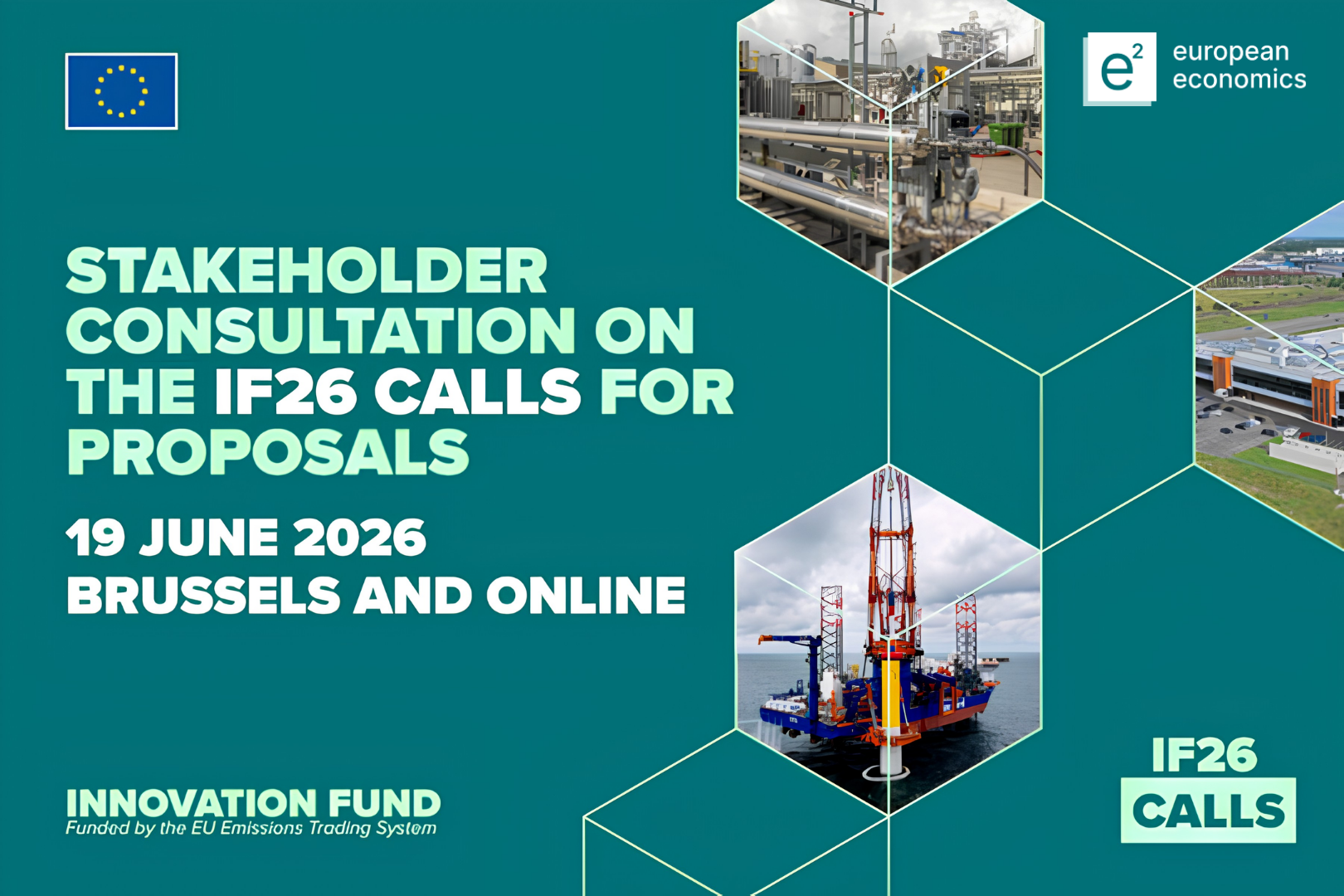
european economics took part in the Stakeholder Consultation Event organised by the European Commission’s Directorate-General for Climate Action (DG CLIMA) on 19 June 2026. Dedicated to the upcoming 2026 Innovation Fund call for proposals (IF26 call), this hybrid event was held at the Albert Borschette Conference Centre in Brussels, with online streaming.
The day had a twofold objective: to present the Innovation Fund’s progress and results, and to gather stakeholder feedback on the design of future calls for proposals. It gave sector stakeholders an opportunity to contribute to the design of the IF26 call, which is still in preparation.
A solid track record in European public funding
Founded in 2009, european economics is an independent firm specialising in State aid and European funding, serving strategic industrial projects across Europe.
- 257 projects accompanied since 2009, representing €106 billion in activity
- €46 billion in public funding secured
- 100% success rate on State aid notifications to the European Commission
- 211 clients, from fast-growing SMEs to large multinational groups, across all industrial sectors
On the Innovation Fund specifically, european economics delivers results above the average for applicants:
- 17 applications supported since the very first call in 2020;
- a 35% success rate, 2.4 times the applicant average (14.8%);
- €111 million secured on average, compared with €68 million for other winners.
On average parameters, the expected grant value of an application rises from around €10 million without specialist support (14.8% x €68 million) to nearly €39 million with european economics (35% x €111 million).
A consultation dedicated to designing the upcoming IF26 call
The morning session took stock of the programme: policy developments and new support mechanisms, the progress made by the Innovation Fund, the main lessons from the 2025 call, Project Development Assistance and the annual Knowledge Sharing Report. The options under consideration for the design of the IF26 call were then presented and opened to participants’ feedback.
The afternoon was devoted to thematic sessions, designed to gather targeted input by segment:
- net-zero technologies;
- small-scale projects and SME-led projects;
- the maritime sector.
The maritime sector is among the sectors newly eligible following the 2023 revision of the EU ETS, which also opened the Fund to aviation and introduced a medium-scale project category. This consultation format allows the Commission to align the design of the IF26 call as closely as possible with the needs of project promoters and sector-specific features.
The Innovation Fund, a key instrument for industrial decarbonisation
The Innovation Fund is the European Union’s fund for climate policy, with a focus on energy and industry. It is one of the world’s largest funding programmes for the deployment of innovative low-carbon and net-zero technologies, with the aim of bringing to market solutions to decarbonise European industry and supporting its transition to climate neutrality while strengthening its competitiveness.
The programme is financed by the EU Emissions Trading System (EU ETS), through the monetisation of 530 million allowances. Its total funding depends on the carbon price: it may amount to about €40 billion from 2020 to 2030, based on a carbon price of €75 per tonne of CO2. The European Commission is responsible for the overall management of the Fund and has delegated implementation to two bodies: the European Climate, Infrastructure and Environment Executive Agency (CINEA), which manages the calls for proposals, evaluation, grant award and project monitoring, and the European Investment Bank (EIB), which monetises the allowances and provides Project Development Assistance.
The projects supported, located in the European Union (as well as in Norway, Liechtenstein and Iceland), fall mainly within the following areas:
- low-carbon technologies in energy-intensive industries;
- carbon capture and utilisation (CCU) and carbon capture and storage (CCS);
- innovative renewable energy generation;
- energy storage;
- net-zero mobility (maritime, aviation, road transport) and buildings.
The Fund finances up to 60% of relevant costs for regular grants, and up to 100% under competitive bidding (auctions). These costs are calculated according to the methodology specific to each call and generally cover capital and operating costs, net of revenues, over the first ten years of operation. The Innovation Fund grant is not State aid: it can be combined with other public funding, whether European or national, within the limit set by the applicable State aid cumulation rules.
How european economics supports Innovation Fund applicants
european economics has supported companies applying to the Innovation Fund, on the large-scale project strand, since the very first call for proposals in 2020. We structure the preparation of the application through a milestone-based process over three months, designed to convey the quality and maturity of the project as effectively as possible.
Beyond the application itself, european economics designs the financial engineering needed to integrate Innovation Fund funding into a comprehensive public funding solution, aligned with the other European and national instruments available.
This approach is illustrated by the case of Leclanché, a Swiss battery manufacturing and energy storage company. european economics supported it in securing Innovation Fund funding for a gigafactory project incorporating a novel sustainable manufacturing process. Selected among the six first winners of the IF24 Battery call (€852 million allocated to these six projects), the project received a grant of several tens of millions of euros. Read the Leclanché case study.
Let’s continue the conversation
european economics’ participation in this consultation is part of its ongoing watch on the European Union’s funding instruments, in support of strategic industrial projects.
Are you preparing a project that could fall under the Innovation Fund or another European public funding instrument and would like to find out more?
Contact us to arrange a meeting!

Discover other articles