

What is TRL?
The Technology Readiness Level (TRL), is a framework used to measure the degree of advancement of an innovation, from early-stage scientific research through to commercial deployment.
Originally developed by NASA in the 1970s, this tool is now widely used in Europe, particularly to structure the evaluation of innovative projects and guide public funding (euraxess.ec.europa.eu, European Commission, 2020).
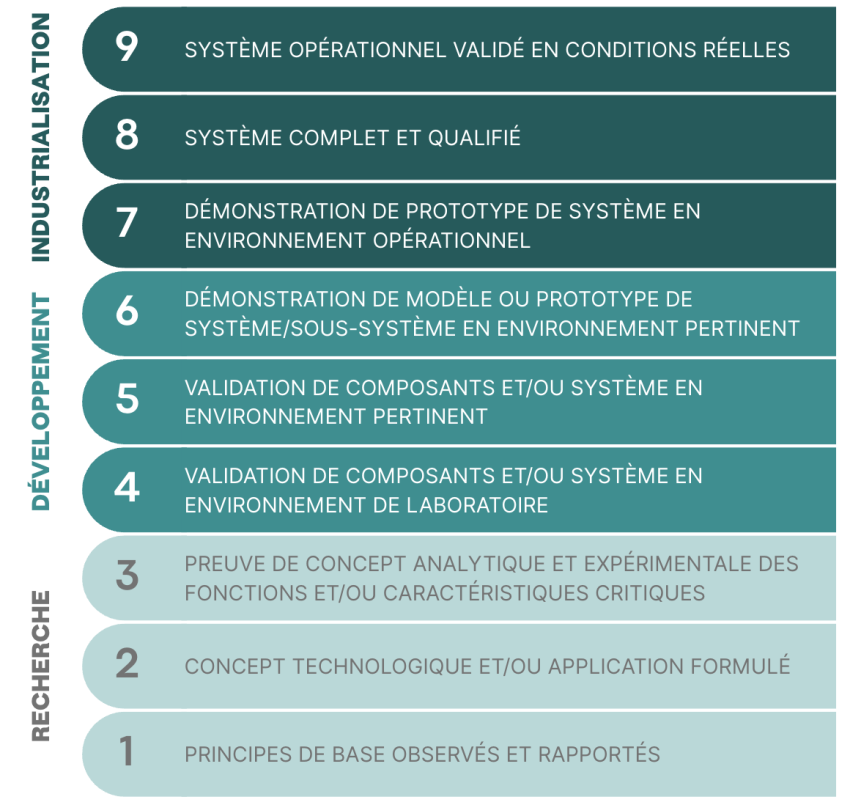
The TRL scale includes 9 levels, which make it possible to position a technology according to its maturity and proximity to the market.
The 9 TRL levels
- TRL 1 – Basic principles observed: Fundamental scientific phenomena are observed and reported. At this stage, research remains exploratory and conceptual.
- TRL 2 – Technology concept formulated: Scientific principles begin to be translated into potential applications. Initial technological hypotheses and feasibility analyses emerge.
- TRL 3 – Analytical and experimental proof of concept: Experimental or analytical work demonstrates the feasibility of the concept. This is the stage of initial scientific validation.
- TRL 4 – Validation in laboratory: A prototype or technological component is developed and tested in a controlled environment to confirm its basic performance.
- TRL 5 – Validation in a relevant environment: The technology is assessed in conditions close to real use. This stage helps identify adjustments required before scaling up.
- TRL 6 – Demonstration of a system or subsystem: A complete system, or a critical subset, is integrated and tested in a relevant environment, with significant performance trials.
- TRL 7 – Demonstration in an operational environment: The technology is demonstrated under real operating conditions. Its robustness, reliability and fitness for purpose are validated.
- TRL 8 – Qualification and certification: The system is finalised, compliant with applicable standards, and ready for production or large-scale deployment.
- TRL 9 – Industrial and commercial deployment: The technology is fully operational, commercialised and used at industrial scale or within its target market.
Why is TRL so important?
TRL has become a common language between companies, investors, public institutions and funding bodies. It notably enables:
- objective positioning of a project’s maturity;
- reduction of investment risk in emerging technologies;
- alignment of funding with the most suitable projects at each stage of development;
- facilitation of dialogue between innovation stakeholders, based on a shared framework.
In other words, TRL helps transform a promising innovation into a structured, understandable and financeable project.
Which European programmes fund each TRL level?
European funding instruments support projects according to their level of technological maturity. Correctly positioning a project on the TRL scale is therefore essential to target the appropriate scheme.
IPCEI (Important Projects of Common European Interest)
IPCEIs support strategic innovation projects for Europe, particularly in industrial sectors considered critical. They generally cover maturity levels ranging from TRL 4 to TRL 8, depending on the nature of the funded activities.
These projects may include:
- technology development;
- industrial demonstration;
- early stages of industrial deployment.
Companies are selected at national level, after which projects are validated by the European Commission.
European Chips Act
The European Chips Act aims to strengthen Europe’s technological sovereignty in the semiconductor sector.
- Pillar 1 (TRL 1 to 4-5) supports research, innovation, semiconductor design, as well as the development of pilot lines and new technological capabilities. It mainly concerns early and intermediate stages of technological maturity.
- Pillar 2 (TRL 9) aims to develop industrial capacities in Europe, particularly in manufacturing, assembly, packaging and testing. It focuses on advanced maturity levels, close to full industrial deployment.
- Pillar 3 establishes a European monitoring, alert and crisis response mechanism for the semiconductor value chain.
Innovation Fund
The Innovation Fund is one of the main European instruments dedicated to low-carbon technologies. It supports the deployment of innovative solutions in the energy, industry and infrastructure sectors.
The fund notably finances:
- large-scale demonstration projects;
- industrialisation projects;
- certain small, medium or pilot projects involving emerging technologies.
Why should project promoters understand TRL?
Mastering the technological maturity level of a project offers several concrete advantages.
1. Identifying the right funding programme
Accurate TRL positioning makes it possible to apply for schemes genuinely suited to the project’s development stage, and to avoid rejection due to misalignment.
2. Structuring the project coherently
The TRL scale provides a clear progression framework. It helps define R&D, validation, industrialisation and market deployment stages.
3. Strengthening the credibility of the proposal
A well-positioned project on the maturity scale appears clearer to evaluators, partners and funders.
4. Facilitating access to public and private funding
Understanding TRL helps better align funding needs with technological risk levels, thereby facilitating the mobilisation of complementary resources.
Advance your project at any TRL level with European Economics
At European Economics, we support companies at different stages of technological maturity.
Whether it involves a proof of concept, an industrial demonstration or scaling up, we help our clients to:
- identify relevant funding opportunities;
- correctly position their project on the TRL scale;
- structure a strong proposal aligned with funders’ expectations.
Our experience spans several TRL levels. Some projects supported by European Economics initially received funding during early development under an IPCEI-ME/CT, before later being supported on industrialisation challenges linked to the European Chips Act. This continuity illustrates our ability to adapt our support to both project maturity and funding timelines.
TRL as a compass for innovation and funding
TRL is not only a technical evaluation tool. It is also a strategic reference point for managing innovation, securing funding and preparing market entry.
For European companies, a solid understanding of this scale makes it possible to:
- better promote their technology;
- access the most relevant support schemes;
- accelerate industrialisation;
- strengthen competitiveness in an increasingly demanding environment.
For any ambitious company, mastering TRLs and their implications therefore represents an essential lever for success within the European innovation ecosystem.
Contact us to position your project on the TRL scale and target the funding programme that matches its maturity.