european economics at the ISIG Executive Summit EU 2026
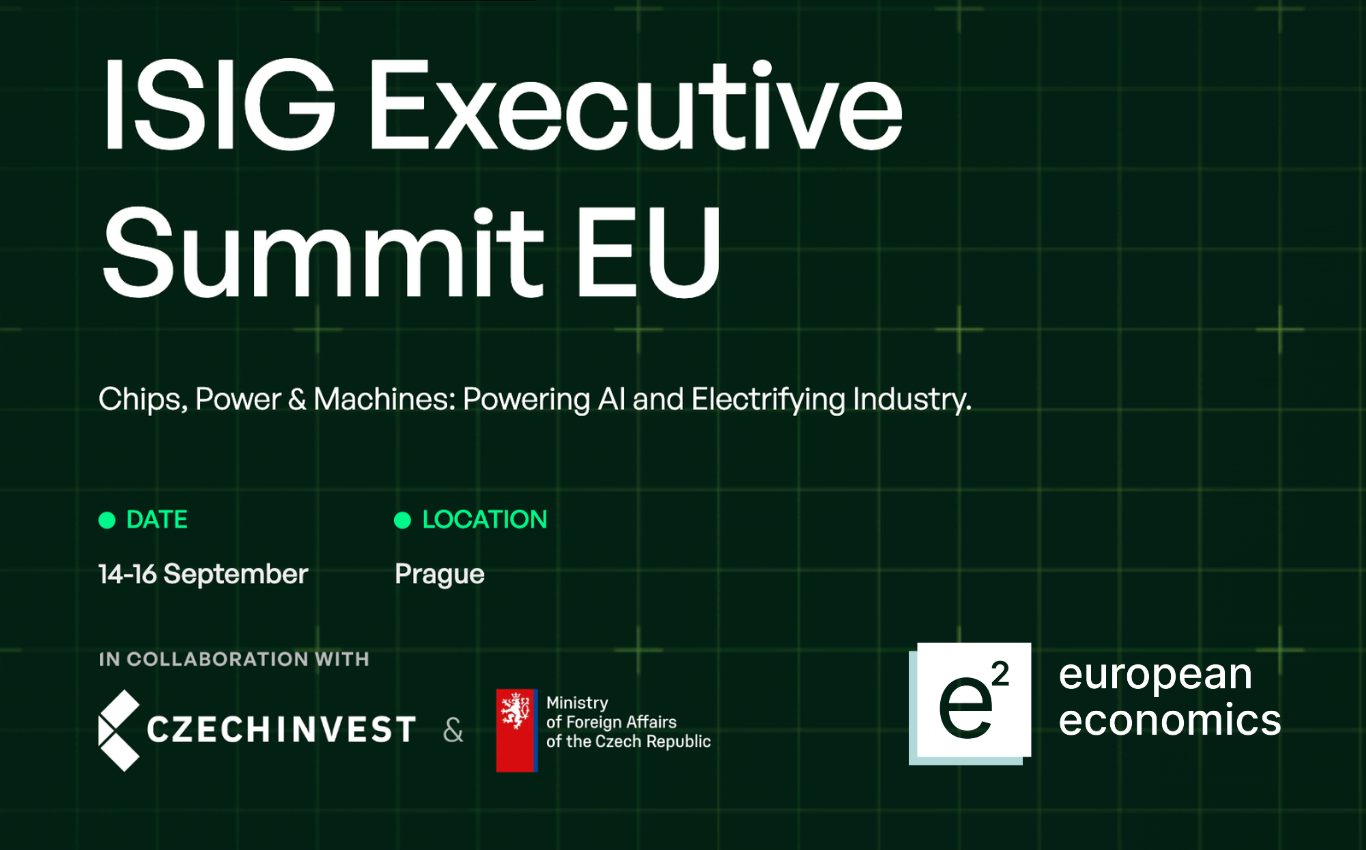
The european economics team attended the ISIG Executive Summit EU 2026 (ISES EU 2026), organised by the International Semiconductor Industry Group (ISIG), which took place in Prague from 14 to 16 September 2026. This sold-out edition marked the fifteenth anniversary of the ISIG.
Held under the theme ‘Chips, Power & Machines: Powering AI and Electrifying Industry’, the summit brought together industry leaders, experts and investors from across Europe’s semiconductor ecosystem at the Czernin Palace, seat of the Czech Ministry of Foreign Affairs. Announced speakers included senior executives from STMicroelectronics, Infineon, Bosch, Li Auto, Fraunhofer IISB and NEURA Robotics.
european economics took part as a Gold sponsor, represented by Marc ISABELLE, Founder and CEO, Marie LAMBERT, Sales and Marketing Director, and Maria Teresa AGUILAR ROJAS, Senior Economic Consultant.
A strong track record in European public funding
Founded in 2009, european economics is an independent consultancy specialising in State aid and European funding, serving strategic industrial projects across Europe.
- 257 projects supported since 2009
- €46 billion in public funding secured
- 100% success rate on State aid notifications to the European Commission
- 211 clients, from fast-growing SMEs to large multinational groups, across all industrial sectors
On IPCEIs alone, european economics has secured €16 billion in funding for 151 projects, across each of the 14 IPCEIs launched to date and in 13 Member States.
In microelectronics, the firm has supported 55 strategic projects across the entire value chain (fabless companies, materials and wafer manufacturers, IDMs, foundries, equipment manufacturers and OEMs), representing €13 billion in public funding secured, from the first R&D programmes to the three microelectronics IPCEIs and the Chips Act.
Marc ISABELLE’s keynote
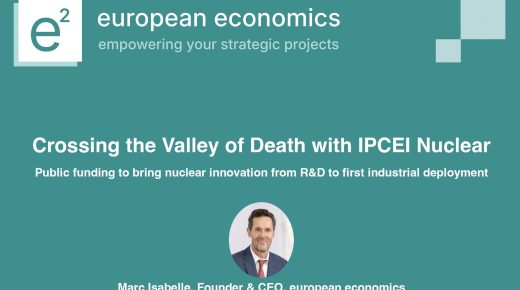
Marc ISABELLE, Founder and CEO of european economics, took the stage on 15 September at 14:40 with his keynote entitled Unlocking public funding for strategic semiconductor projects.
Addressing the participants of the ISIG Executive Summit EU 2026, our Founder and CEO offered a practical reading of the public funding opportunities open to the semiconductor industry in Europe, one of the largest beneficiaries of State aid in the Union. His keynote highlighted several key messages:
- Semiconductors meet all three priorities of the EU agenda, decarbonisation, innovation and competitiveness, resilience: public funding is available at every step of the value chain, from R&D to manufacturing.
- Pillar 2 of the Chips Act provides support for manufacturing investment unparalleled in any other industry, for first-of-a-kind facilities in Europe, with the aid sized on the funding gap against an alternative investment outside the EEA.
- The IPCEI Advanced Semiconductor Technologies, currently in preparation with Commission approval expected in 2027, broadens the scope of the previous IPCEI ME/CT to the whole value chain (equipment, EDA, materials, 300 mm GaN and SiC), on a tighter timeline and with more demanding aid-intensity rules.
- The proposed Chips Act 2.0 and its ‘Strategic Projects’, co-invested at European level, offer a promising route to catching up on advanced technologies, but its budget will depend on the next multiannual financial framework and current State aid rules will continue to apply until 2028.
- Design the project and its funding route together, from day one: above €50 million in aid, the European Commission’s approval is required before the first payment, a one- to two-year process that must be prepared well in advance.
Three days at the heart of Europe’s semiconductor ecosystem
The ISIG Executive Summit EU 2026 opened on 14 September with two industrial site visits: a guided technical tour of UJP Praha, followed by a visit to Hitachi Energy’s semiconductor factory, covering wafer production, front-end and back-end processes and testing operations.
On 15 and 16 September, the programme at the Czernin Palace covered the sector’s main priorities: the future of semiconductors in Europe, power electronics for electric mobility (800V architectures, silicon carbide (SiC) and gallium nitride (GaN)), edge intelligence for robotics and autonomous systems, the processes and materials enabling large-scale SiC and GaN production, the intelligent fab, market outlook and the future of wide-bandgap (WBG) semiconductors. A dedicated session addressed the implications of the proposed Chips Act 2.0 for power, industrial and automotive technologies, and another the semiconductor industry in the Czech Republic.
Alongside the conference sessions, european economics attended the gala evening held at the Národní dům na Vinohradech.
Semiconductors, a priority for European public funding
european economics’ participation in ISES EU 2026 comes at a time when public instruments dedicated to semiconductors are being strengthened.
The Chips Act, in force since 2023, introduced a specific State aid exemption for first-of-a-kind production facilities in Europe (Integrated Production Facilities and Open EU Foundries), with notification to the Commission from the first euro of aid. On 3 June 2026, the European Commission presented a proposal for its revision, the Chips Act 2.0 (COM(2026) 504), currently under examination by the European Parliament and the Council.
On the IPCEI side, the IPCEI ME/CT (Microelectronics and Communication Technologies), approved on 8 June 2023, brought together 14 Member States and 56 companies for €8.1 billion in aid. Its successor, the IPCEI Advanced Semiconductor Technologies, is being structured under German coordination: the first projects were pre-notified to the Commission in July 2026 and approval is expected in 2027. european economics is supporting 14 projects applying to this IPCEI in 4 Member States.
Let’s continue the conversation
european economics’ presence at the ISIG Executive Summit EU 2026 confirms its expertise in European public funding and its commitment to the semiconductor industry, from R&D through to first industrial deployment.
Were you unable to meet us in Prague and would like to discuss public funding opportunities for your projects in semiconductors or strategic industrial technologies?
Contact us to arrange a meeting.


Discover other articles