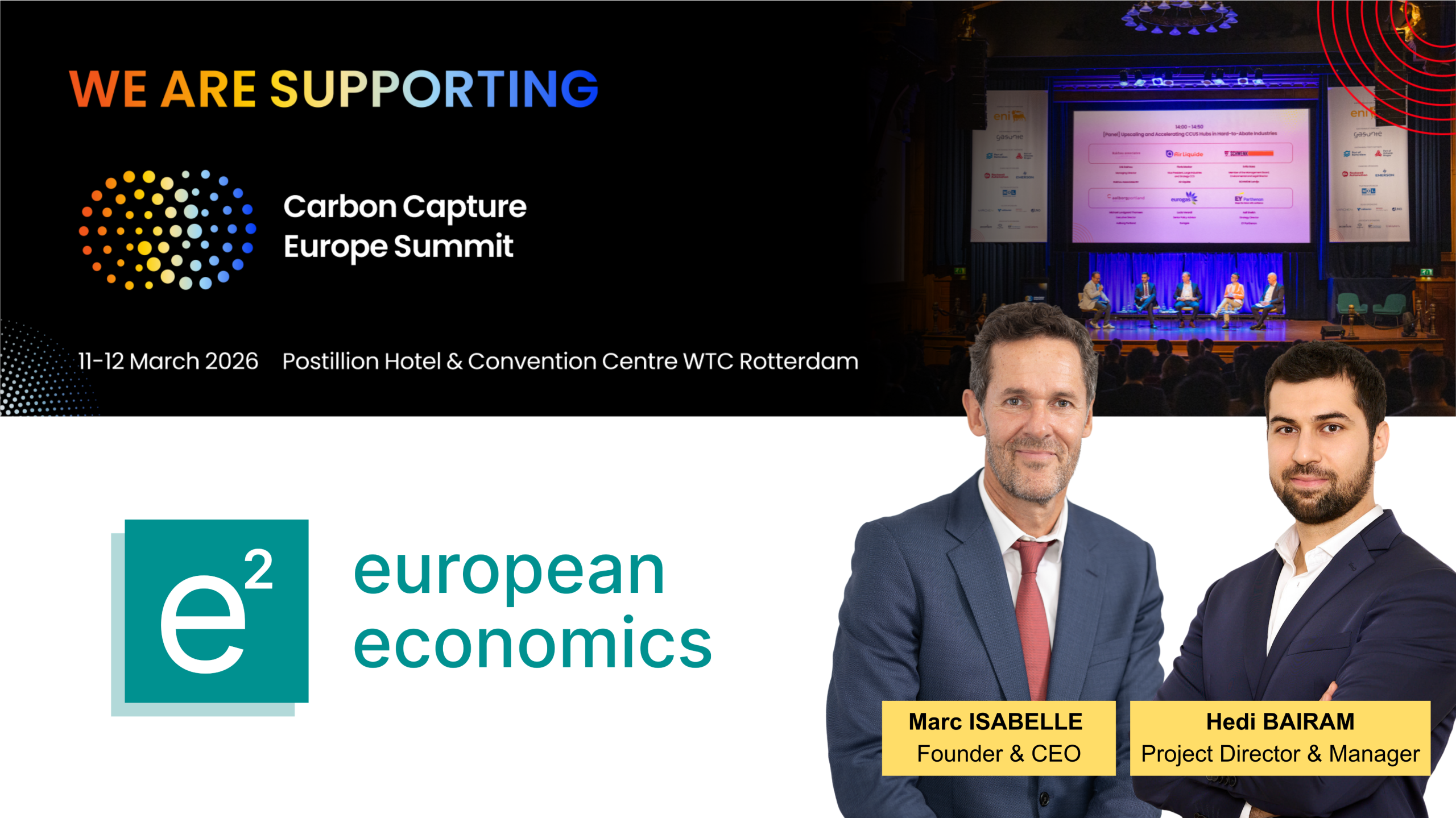
european economics at the Carbon Capture Europe Summit 2026
The european economics team attended the Carbon Capture Europe Summit 2026 (CCES2026) in Rotterdam.
This event brought together public decision-makers, industrial players, investors and infrastructure stakeholders around a central issue for Europe: the large-scale deployment of carbon capture, utilisation and storage (CCUS) technologies.
The 2026 edition placed particular emphasis on financing models, regulatory developments and the structuring of integrated CO₂ value chains at European level.
A strong positioning in industrial decarbonisation and public funding
Since 2009, european economics has supported strategic industrial projects across Europe, with recognised expertise in public funding instruments and State aid.
At CCES2026, we highlighted several key figures:
- €43 billion in public funding secured
- 250 projects supported across Europe
- 100% success rate in State aid notifications to the European Commission
Our services cover the entire project lifecycle, from funding strategy to securing funding and implementation.
CCUS in Europe: strong momentum, structural challenges
During his keynote, our Project Director & Manager Hedi BAIRAM presented an overview of CCUS in Europe in 2026.
At European level, momentum is accelerating:
- The European Industrial Carbon Management Strategy (2024) sets a target of at least 50 Mt of CO₂ stored annually by 2030, with further scaling towards 2040
- First fully integrated value chains are emerging, notably with the Brevik project in Norway
- New CO₂ infrastructure projects are being developed under the Projects of Common Interest
- A European legislative initiative on CO₂ transport and markets is expected in 2026
However, several structural constraints remain:
- CCUS projects are not yet economically viable on a standalone basis, even with the EU ETS price signal
- High upfront capital expenditure requirements
- A regulatory framework that remains fragmented across Member States
- Limited visibility on storage capacity availability
- A geographical concentration around the North Sea basin
These elements confirm that public funding remains a structuring lever for the development of CCUS in Europe.
Public funding as a key enabler
A central message of the keynote is that public funding is currently an essential lever to make CCUS projects bankable.
At European level:
- Innovation Fund: financing innovative industrial decarbonisation projects
- Connecting Europe Facility (CEF): CO₂ transport infrastructure
- Horizon Europe: R&D and demonstration projects
At national level:
- investment aid (Capex)
- revenue stabilisation mechanisms (CCfDs, SDE++, etc.)
From a regulatory perspective, State aid is based on two core principles:
- necessity: the project would not proceed without support
- proportionality: no overcompensation
Public funding helps to reduce risk and bridge the profitability gap of projects.
Building a structured financing approach (“financing stack”)
Discussions, particularly during the panel “Europe’s CCUS Financing Playbook” with our President and Founder Marc ISABELLE, confirmed that no single instrument is sufficient on its own.
The most robust projects rely on a combined financing stack:
- EU ETS as a baseline economic signal
- Innovation Fund for first industrial deployment
- CEF for infrastructure
- national mechanisms to complete the business case
This approach enables projects to reach bankability.
Marc also highlighted a key success factor: integrating the funding strategy from the project design phase, by structuring:
- the full value chain (capture, transport, storage)
- contractual maturity
- regulatory alignment
- financial robustness
Conclusion: moving to industrial scale
CCES2026 confirms a major shift: the challenge is no longer only technological, but now economic and systemic.
The central issue is bankability and scaling projects to industrial level.
Public funding, combined with stronger European coordination, will remain critical to structure viable CCUS value chains.
Are you developing a CCUS or industrial decarbonisation project? Contact us to arrange a meeting.


Discover other articles