
The European Commission defines the bioeconomy as the set of activities that create value from biological resources by delivering sustainable solutions in the form of products, services and technologies. These activities cover the entire cycle, from agriculture and forestry to processing value chains, including biorefineries, biomanufacturing, biotechnologies and food uses.
Within the European Union, the value of this sector was estimated at EUR 2.7 trillion in 2023 (Lasarte López, M’barek, 2025) and it employs around 17.2 million people, a significant share of whom are located in rural areas (EC, 2025). It is regarded as a lever to reconcile economic development with environmental protection (EC, 2025).
The bioeconomy therefore acts as a driver of decarbonisation, competitiveness and resilience, aiming to substitute part of fossil-based inputs with solutions based on biological resources, while strengthening strategic autonomy and the stability of value chains.
It covers:
- The production and valorisation of biomass, derived from crops, agricultural residues, by-products or organic waste, with the aim of transforming it into higher value-added products.
- Agri-food value chains constitute a core pillar of the bioeconomy, encompassing supply security, food innovation, and the articulation between food uses and industrial uses of biomass.
- Biomaterials are developed from biological resources and are intended to replace fossil-based materials in industry, including bio-based plastics, plant fibre composites and bio-based chemical intermediates.
- Bioenergy and biofuels mobilise renewable biological resources, particularly certain categories of residues, waste or used oils, in line with usage trade-offs and sustainability constraints.
Why is the bioeconomy a priority for the European Union?
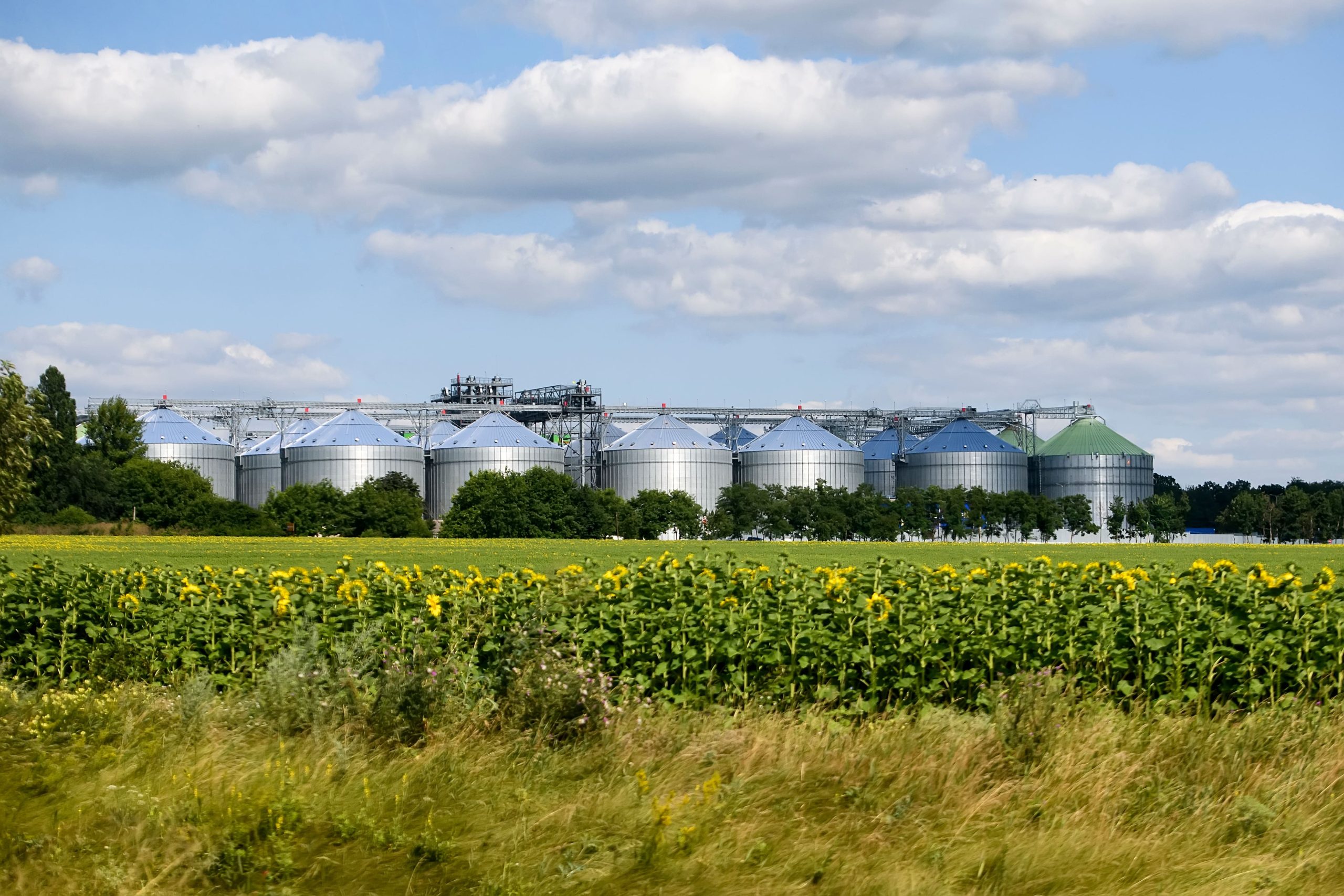
Grain elevator, Ukraine
The prioritisation of the bioeconomy is driven by four converging objectives:
- Decarbonising the economy and reducing environmental impacts (climate, pollution, biodiversity), in line with the European Green Deal.
- Reducing dependencies on imported fossil-based materials (materials, molecules, inputs), while strengthening industrial resilience.
- Accelerating the transition towards a circular economy, by improving material efficiency and closing loops (priority to reduction, reuse and recycling, including in the context of plastics).
- Supporting rural and coastal areas through the development of new value chains and economic opportunities (jobs and infrastructure).
The bioeconomy is therefore at the core of the European strategy, with a clear ambition: to reduce dependence on fossil-based materials, decarbonise value chains and leverage locally available renewable resources.
What challenges shape the future of the bioeconomy in Europe?
The following challenges structure the bioeconomy and are expected to become strategic levers:
- Economic competitiveness vis-à-vis fossil-based sectors and industrial scale: the challenge is not only technological; it lies in scaling from pilot to industrial deployment, financing first-of-a-kind projects and achieving cost reductions through scale. The Commission highlights investment needs and financing gaps that slow down market entry (European Commission, 2025).
- Availability and sustainability of biological feedstocks: the European Environment Agency underlines trade-offs between uses (food and feed, materials, energy, nature conservation and carbon storage). The robustness of bio-based sectors therefore depends on access to sustainable inputs (residues, by-products, waste) and prioritisation of uses (European Environment Agency, 2023).
- Supply chains and industrialisation: scaling bio-based innovations into continuous production lines involves logistical, storage and standardisation challenges. Companies must manage feedstock variability, traceability and quality at industrial scale. The Commission also highlights a key bottleneck: limited access to piloting and upscaling infrastructure, particularly affecting start-ups and scale-ups (European Commission, 2025).
- Regulation, standards and market acceptance: the market uptake of bio-based materials depends on sector-specific requirements and the ability to demonstrate the origin and sustainability of inputs. The Commission stresses the need for clarity on sourcing, labelling and the use of bio-based plastics, as well as convergence towards a common understanding to avoid fragmentation of the single market (European Commission, 2022).
What European initiatives and instruments support the bioeconomy sector?
- Horizon Europe (Cluster 6): a key funding programme for R&D in bioeconomy, food security and circularity, with regular calls (European Commission).
- IPCEI on Biotechnologies: this initiative aims to structure and strengthen European value chains in industrial biotechnology, in line with objectives of strategic resilience, ecological transition and bioeconomy (European Commission, 2025). It supports projects targeting breakthrough innovation and first industrial deployment (FID). It is structured around three pillars:
- IPCEI Biobased Chemicals: development and industrialisation of bio-based chemicals to reduce dependence on fossil resources and support new industrial value chains.
- IPCEI Biobased Materials: scaling up bio-based materials with circularity objectives and gradual substitution of certain critical raw materials.
- IPCEI Biotechnologies for Food and Feed: biotechnological innovations for food security, nutritional sustainability and reduced environmental pressures on agricultural systems.
How does european economics support bioeconomy project developers?
european economics provides expertise to biotechnology and bioeconomy stakeholders at every stage of project development:
- Identification of relevant public funding: at European and national level, to support the development of innovative solutions.
- Project structuring and preparation: ensuring compliance with programme requirements (innovation, economic impact).
- Monitoring of administrative and regulatory processes: in relation to European and national authorities.
Conclusion
The bioeconomy represents a strategic opportunity for Europe, both for decarbonisation and the creation of local value chains. While challenges remain (costs, feedstocks, standards, industrialisation), they can be addressed through well-structured, financed and coordinated projects at European level.
european economics supports stakeholders seeking to transform bio-based innovations into competitive industries.

